Khayal
ख्याल
In short
The main form of Hindustani classical singing today: a two-part bandish (sthayi and antara) developed with alaap, bol-alaap, sargam and taans. The bada khayal is sung in vilambit laya, the chhota khayal in madhya or drut laya.
आज के हिंदुस्तानी शास्त्रीय गायन का प्रमुख गीत प्रकार। स्थायी और अंतरा वाली बंदिश को आलाप, बोल-आलाप, सरगम और तानों से बढ़ाया जाता है। विलंबित लय में बड़ा ख्याल और मध्य या द्रुत लय में छोटा ख्याल गाया जाता है।
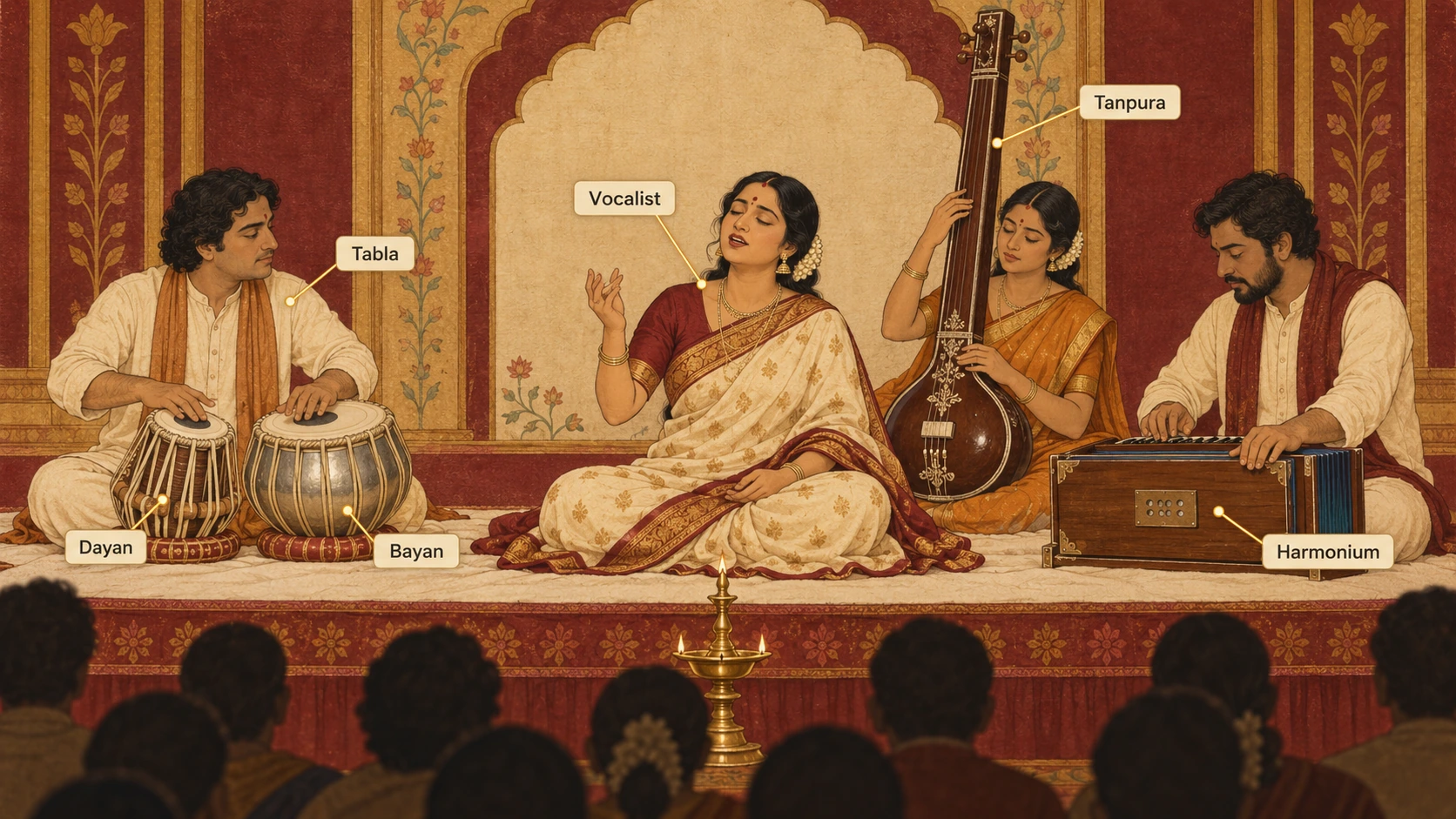
The form you sing most
From level 1Khayal (ख्याल) comes from a Persian word meaning imagination. It is the form that fills most Hindustani vocal concerts today, and most of what you sing in the ABGMVM practical is khayal.
The bandish you learn at Prarambhik, a short composition in Teentaal sung in medium tempo, is already a small chhota khayal. Later you add the alaap and taans that grow out of it, and at Praveshika Dwitiya you meet its slow, spacious partner, the bada khayal.
How it is structured
From level 2A khayal bandish has only two parts:
| Part | Where it sits | Job |
|---|---|---|
| Sthayi | mostly mandra and madhya saptak | states the raga and the theme; its opening phrase (the mukhda) leads into sam and is the refrain you keep returning to |
| Antara | climbs to taar Sa and around it | shows the raga's upper half, then comes back down to the mukhda |
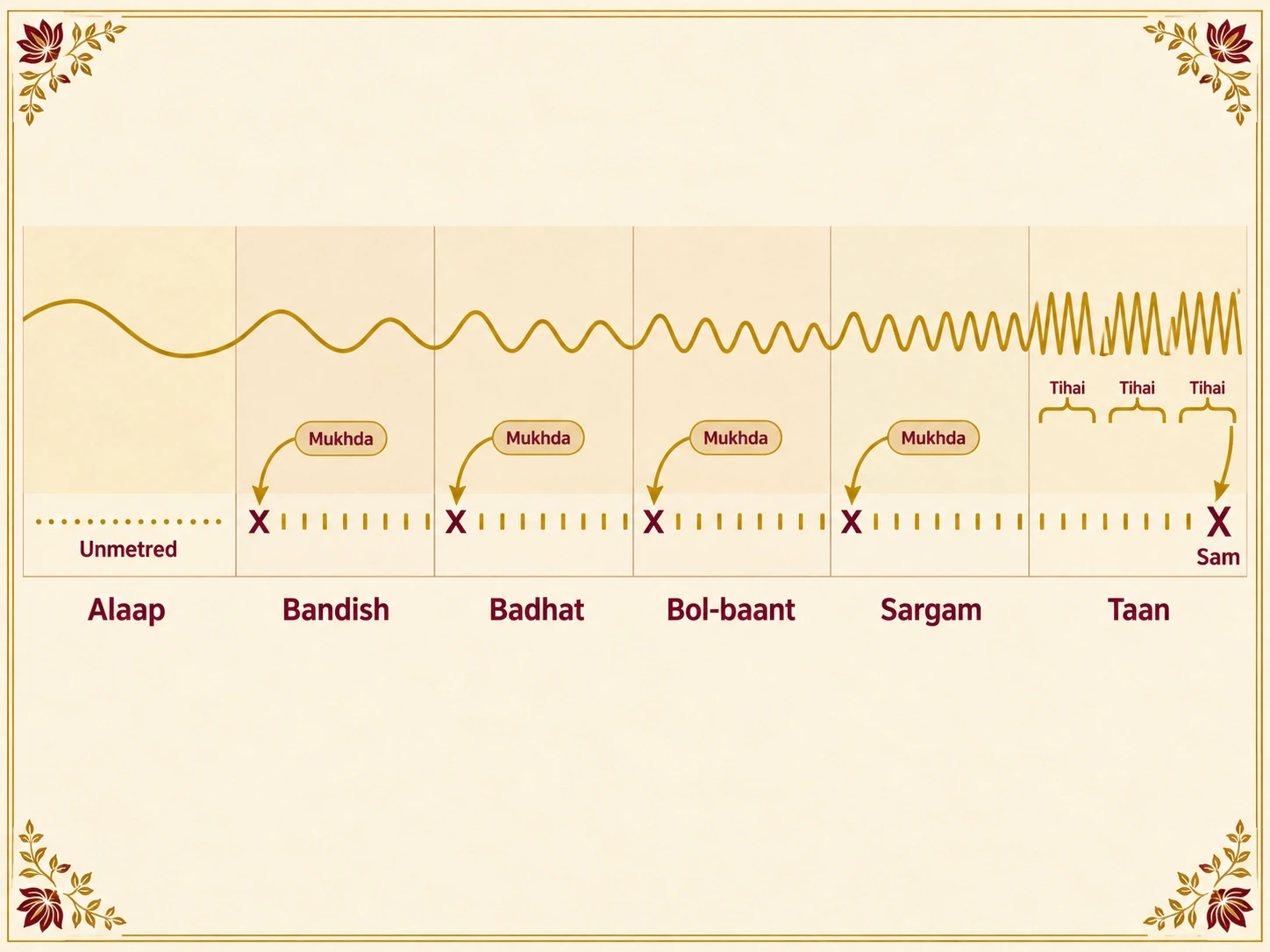
Around the bandish the singer builds a performance, roughly in this order:
| Stage | What happens |
|---|---|
| Alaap (aochar) | a short, unmetred opening on aakar that sketches the raga |
| Bandish | sthayi and antara sung with the tabla |
| Badhat (vistar) | the raga is unfolded note by note, often using the words of the bandish (bol-alaap), always returning to the mukhda |
| Bol-baant / bol-taan | the words are broken up rhythmically or sung in fast runs |
| Sargam | improvised passages sung in swara names |
| Taan | fast runs on aakar, ending with a tihai or a clean landing on sam |
Ornaments such as meend, gamak, murki and khatka are all at home in khayal.
Bada khayal and chhota khayal
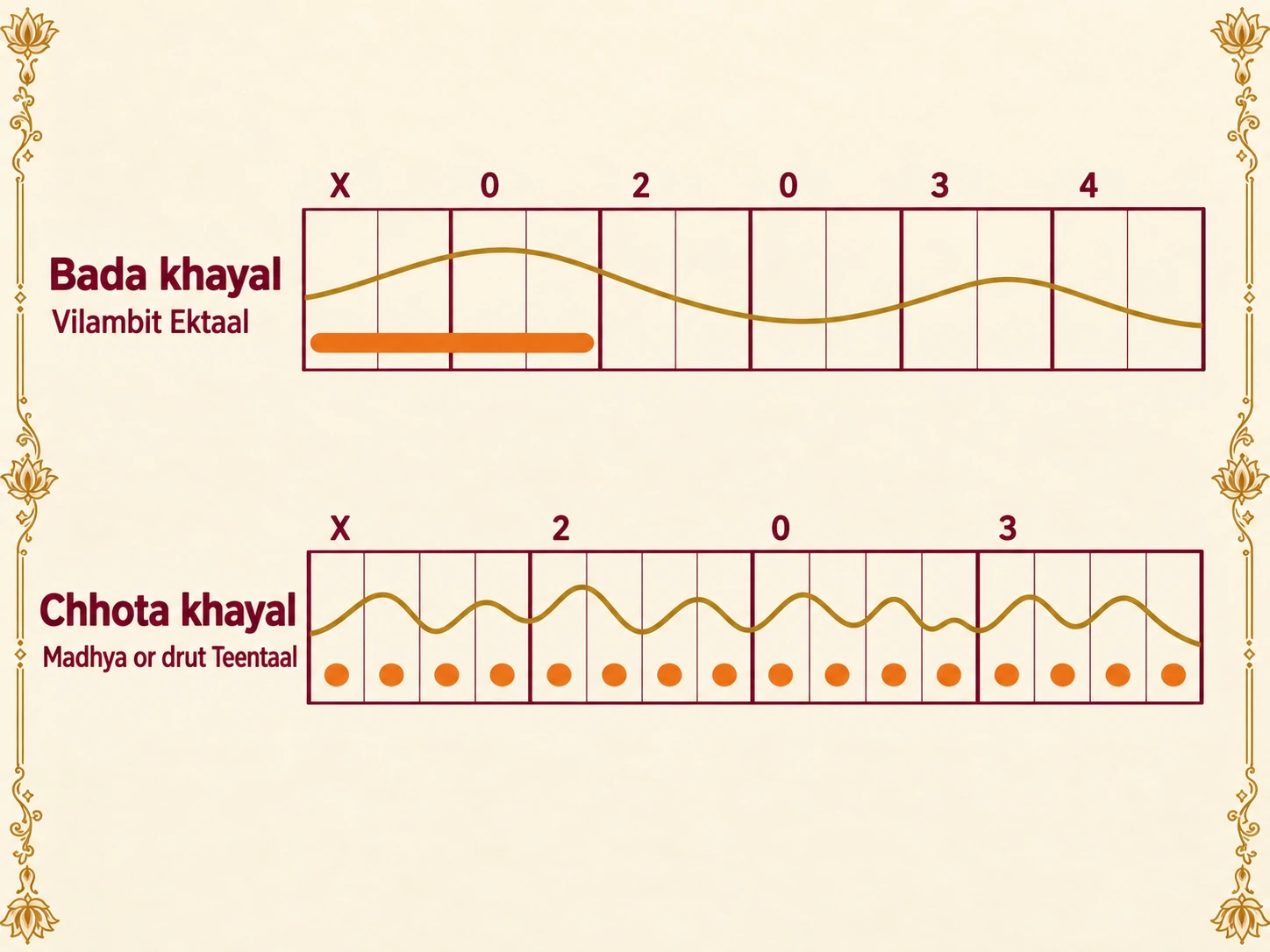
From level 3In a full performance the two are sung back to back in the same raga: first the bada khayal, then the chhota khayal.
| Bada khayal | Chhota khayal | |
|---|---|---|
| Laya | vilambit (slow) | madhya or drut |
| Typical taals | vilambit Ektaal (12), Jhumra (14), Tilwada (16), vilambit Teentaal | Teentaal (16), drut Ektaal (12), Jhaptaal (10), Roopak (7) |
| Character | spacious, serious; most of the raga's development happens here | brisk and compact; showcases taans and rhythm |
| Words | few, stretched across many matras | sung more or less as spoken |
At Praveshika Dwitiya you learn only the bandish of a bada khayal (in Yaman or Bhupali), without elaboration. From Madhyama Pratham you are expected to develop it.
Where khayal came from
From level 6Tradition credits Amir Khusrau (13th–14th century) with starting khayal, but historians treat this as legend. What is certain is that khayal came into its own in 18th-century Delhi at the court of Muhammad Shah "Rangile". There Niyamat Khan "Sadarang" and his nephew Firoz Khan "Adarang" composed hundreds of bada khayal bandishes. Their pen names still appear in the last line of many bandishes you will learn.
The oldest khayal gharana is Gwalior, shaped in the 19th century by Haddu Khan and Hassu Khan. Pt. Vishnu Digambar Paluskar, whose disciples founded the ABGMVM, learned from Pt. Balkrishnabuwa Ichalkaranjikar of this tradition. Other major khayal gharanas include Agra, Jaipur-Atrauli, Kirana and Patiala; each has its own way of handling alaap, bandish and taan.
How to practise it, and what the examiner listens for
From level 2Practise
- Learn the bandish from notation until you can sing it with the tanpura and taal without looking.
- Clap the taal while singing. Know on which matra the mukhda starts so that its key word lands exactly on sam.
- Add elaboration slowly: a few short alaaps first, then taans, each one coming back to the mukhda.
The examiner listens for
- the raga's correct notes and phrases, with no forbidden swaras slipping into alaap or taans;
- the bandish sung exactly as composed, words and swaras;
- steady laya and a clean return to sam;
- a voice tuned to your Sa throughout.
What each level asks
| Level | Khayal requirement |
|---|---|
| Prarambhik | one bandish per raga, with aaroha-avaroha |
| Praveshika Pratham | a bandish with alaap and taans; a geet in Jhaptaal, Roopak or Ektaal |
| Praveshika Dwitiya | madhya laya khayals with alaap and taan, about 10 minutes; a bada khayal bandish in Yaman or Bhupali |
| Madhyama Pratham | vilambit and drut khayal in Bhupali, Yaman, Bageshree and Bihag, about 10 minutes each |
| Madhyama Dwitiya | vilambit khayal (in two different taals) and drut khayal, about 15 minutes each |
| Visharad | your own alaap and taans; 15 minutes per raga, rising to 20–30 minutes |
| Alankar | 30–45 minutes per raga with vilambit and drut compositions |
Exam questions
Answer these the way the examiner expects: short and exact.
What are the two parts of a khayal bandish? Level 2
Sthayi and antara.
What is a khayal? Level 3
The main form of Hindustani classical singing: a bandish in sthayi and antara, developed with alaap, bol-alaap, sargam and taan.
How does a bada khayal differ from a chhota khayal? Level 3
The bada khayal is in vilambit laya (vilambit Ektaal, Jhumra, Tilwada); the chhota khayal is in madhya or drut laya (Teentaal, drut Ektaal, Jhaptaal).
Who composed many of the bada khayals sung today? Level 6
Niyamat Khan "Sadarang" and Firoz Khan "Adarang", at the 18th-century court of Muhammad Shah in Delhi.
Which is the oldest khayal gharana? Level 6
Gwalior.
Related
Learning this with a teacher
These pages will take you a long way on theory. The singing needs a guru — live online classes, one level at a time, with exam preparation built in.