Bandish
बंदिश
In short
A bandish is a composition with words, set in a raga and bound to a taal. Its main parts are the sthayi and antara.
राग और ताल में बँधी हुई, शब्दों सहित स्वररचना को बंदिश कहते हैं। इसके मुख्य भाग स्थायी और अंतरा हैं।
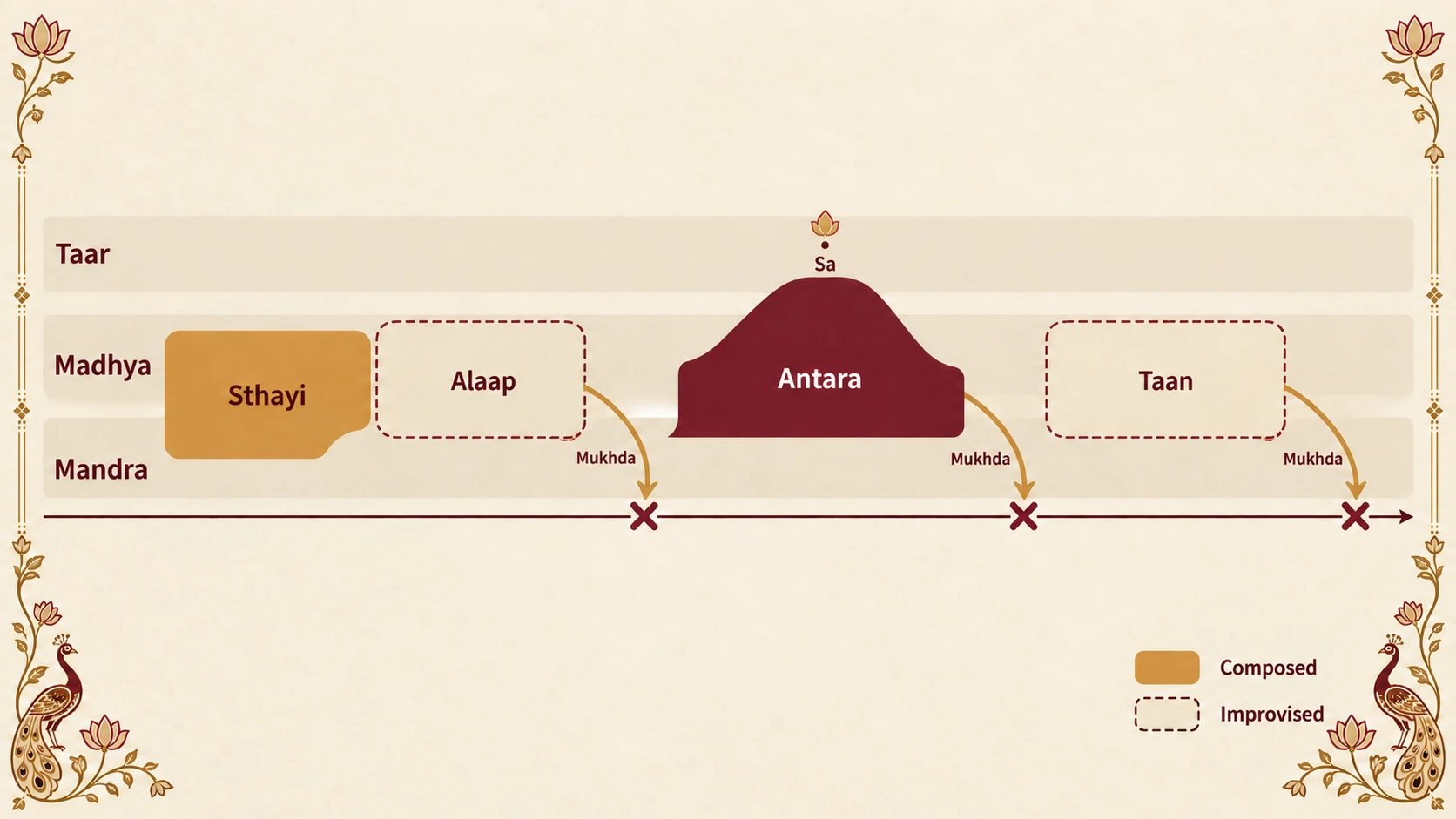
What a bandish is
From level 2A bandish (बंदिश, "something bound") is a fixed composition: words (sahitya), a melody in a particular raga, and a place in a particular taal. In khayal it is also called a cheez (चीज़).
The bandish is the anchor of a performance. Alaap and taan are improvised around it, but the singer keeps returning to it, so it must be learned exactly: every note, every word, and the exact matra on which it begins.
Sthayi and antara
From level 2- Sthayi (स्थायी): the first part. It establishes the raga, mostly in the madhya and mandra saptaks, and is the part you keep coming back to.
- Antara (अंतरा): the second part. It climbs into the upper half of the madhya saptak and usually touches taar सां, then comes back down to rejoin the sthayi.
A useful sign that you have learned an antara correctly: it should feel like a rise and a return, never like a separate song.
The mukhda and how a bandish is written
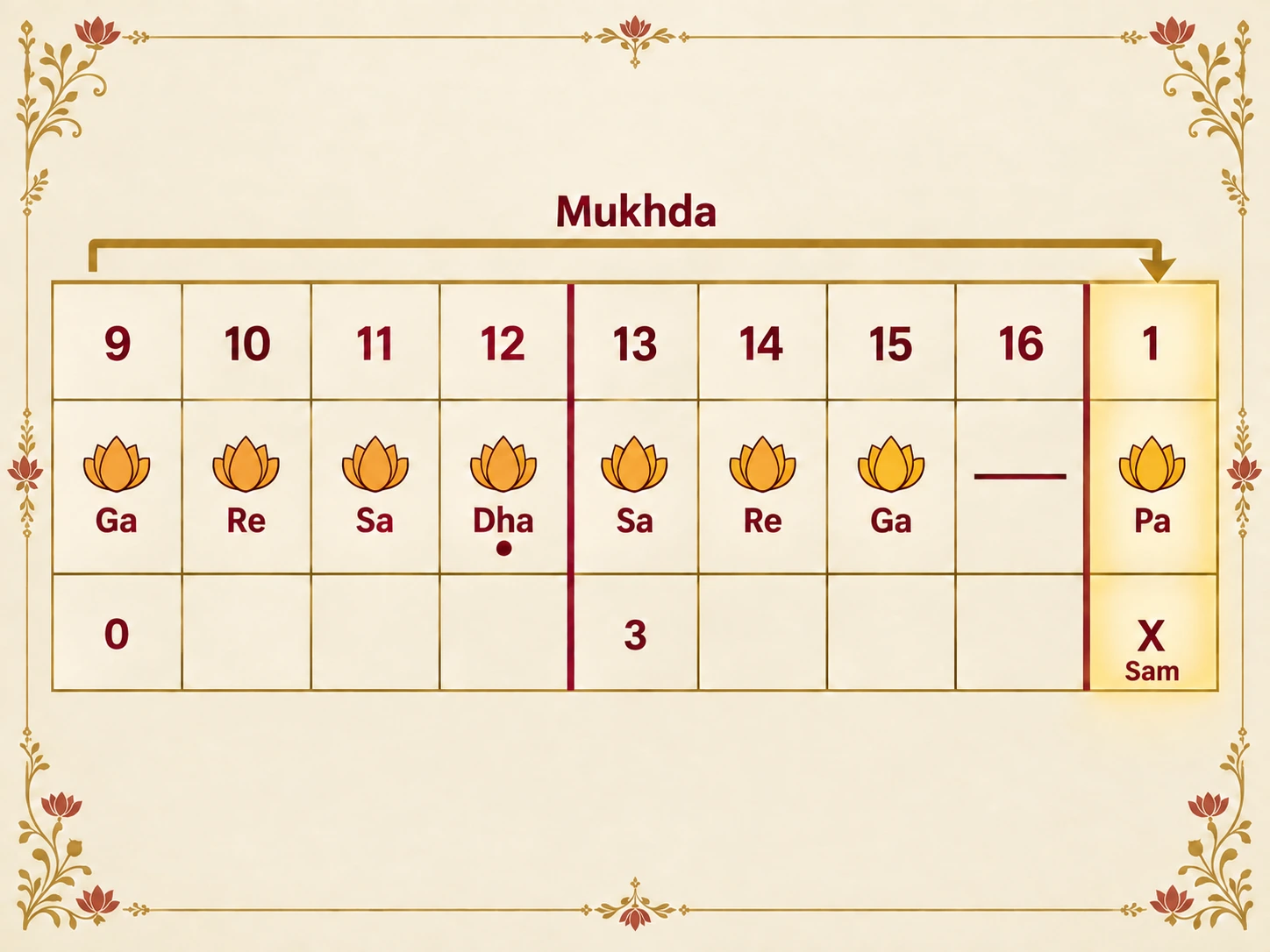
From level 3The mukhda (मुखड़ा, "face") is the opening phrase of the sthayi that leads into sam. It is the line you sing after every alaap and taan to come home. Many khayal bandishes do not start on sam; the mukhda starts a few matras earlier and arrives on sam.
A bandish is written in Bhatkhande notation as rows of three lines: swaras on top, words beneath (one syllable under each note, with ऽ where a syllable is held), and taal signs at the bottom. For example, a mukhda in Teentaal that starts at matra 9 would be laid out like this (an illustrative Bhupali phrase, not a real composition):
| Matra | 9 | 10 | 11 | 12 | 13 | 14 | 15 | 16 | 1 |
|---|---|---|---|---|---|---|---|---|---|
| Swara | ग | रे | सा | ध़ | सा | रे | ग | ऽ | प |
| Words | (one syllable under each note) | ||||||||
| Sign | 0 | 3 | X |
The sthayi is written out first, then the antara, each starting from the matra where it actually begins.
The four parts of a composition
From level 3The level 3 syllabus asks for the four avayavs (parts) of a song:
| Part | Role |
|---|---|
| Sthayi (स्थायी) | the opening; establishes the raga in the lower and middle range |
| Antara (अंतरा) | rises to the upper range and taar सां |
| Sanchari (संचारी) | "wandering": moves freely through all three saptaks |
| Abhog (आभोग) | the concluding part; often carries the composer's name (mudra) |
A dhrupad traditionally has all four. A khayal usually has only sthayi and antara.
Khayal comes in two kinds, both at level 3: the vilambit (bada) khayal, in a slow taal such as vilambit Ektaal, and the drut (chhota) khayal, usually in Teentaal or drut Ektaal. In performance the bada khayal comes first and the chhota khayal follows.
Exam questions
Answer these the way the examiner expects: short and exact.
What is a bandish? Level 2
A fixed composition with words, set in a raga and a taal.
What are the sthayi and antara? Level 2
Sthayi: the first part, mostly in the lower and middle range. Antara: the second part, rising to taar सां.
Name the four parts of a song. Level 3
Sthayi, antara, sanchari and abhog.
What is a mukhda? Level 3
The opening phrase of the sthayi that leads to sam; the singer returns to it after each alaap and taan.
Which parts does a khayal usually have? Level 3
Only sthayi and antara. Dhrupad has all four.
Related
Learning this with a teacher
These pages will take you a long way on theory. The singing needs a guru — live online classes, one level at a time, with exam preparation built in.