Bhajan
भजन
In short
A devotional song in light classical style, usually in Keherwa or Dadra. The ABGMVM syllabus asks for a bhajan and for the Mandal prayer, "Jai Jagdish Hare".
ईश्वर की भक्ति में गाया जाने वाला उपशास्त्रीय या सुगम गीत, प्रायः कहरवा या दादरा ताल में। मंडल के पाठ्यक्रम में एक भजन तथा मंडल की प्रार्थना "जय जगदीश हरे" सीखनी होती है।
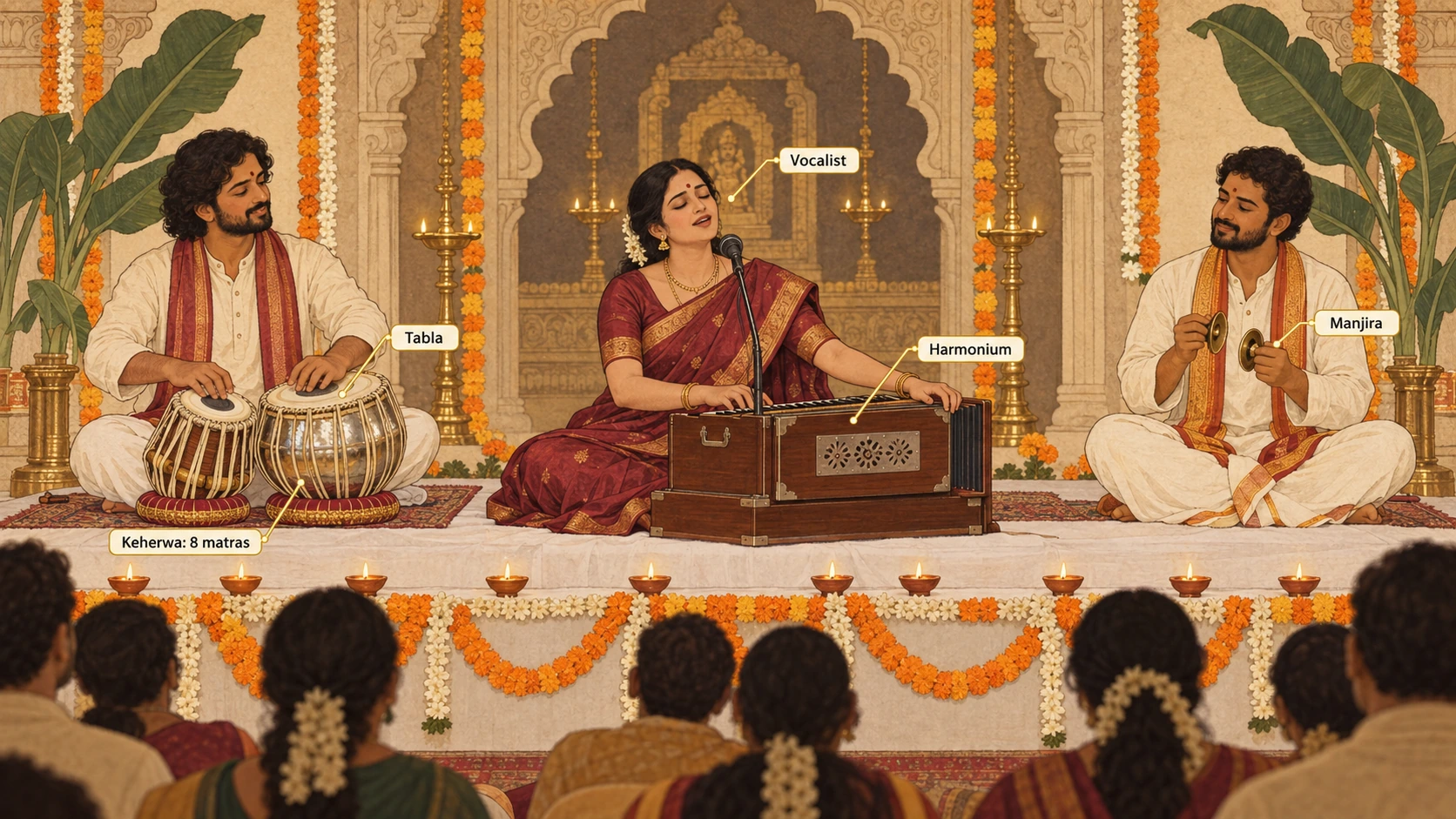
Devotion in song
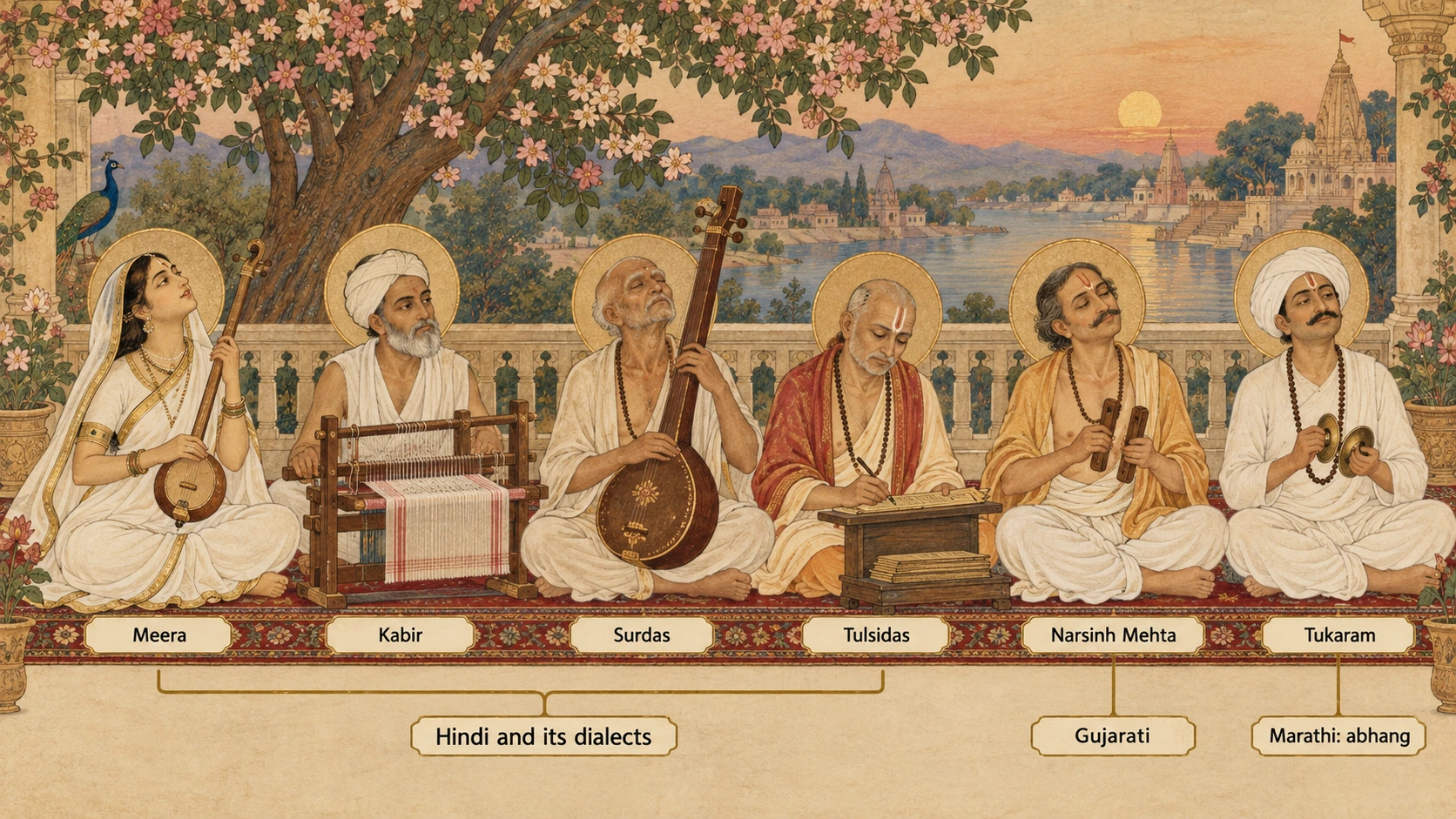
From level 2A bhajan is a song of devotion (bhakti) to God. Most bhajans sung today were written by the poet-saints of the bhakti movement: Meera, Kabir, Surdas, Tulsidas in Hindi and its dialects, Narsinh Mehta in Gujarati, and Sant Tukaram and others in Marathi, whose songs are called abhangs.
The bhajan sits in light classical (sugam) music. Its tune is often drawn from a raga, such as Bhairavi, Khamaj, Kafi, Yaman or Bhupali, but it may mix ragas or follow a folk melody. The words and their feeling (bhava) come first.
Bhajan has a special place in the Mandal. Pt. Vishnu Digambar Paluskar, whose disciples founded the ABGMVM, made devotional singing central to his teaching and concerts.
How it is structured
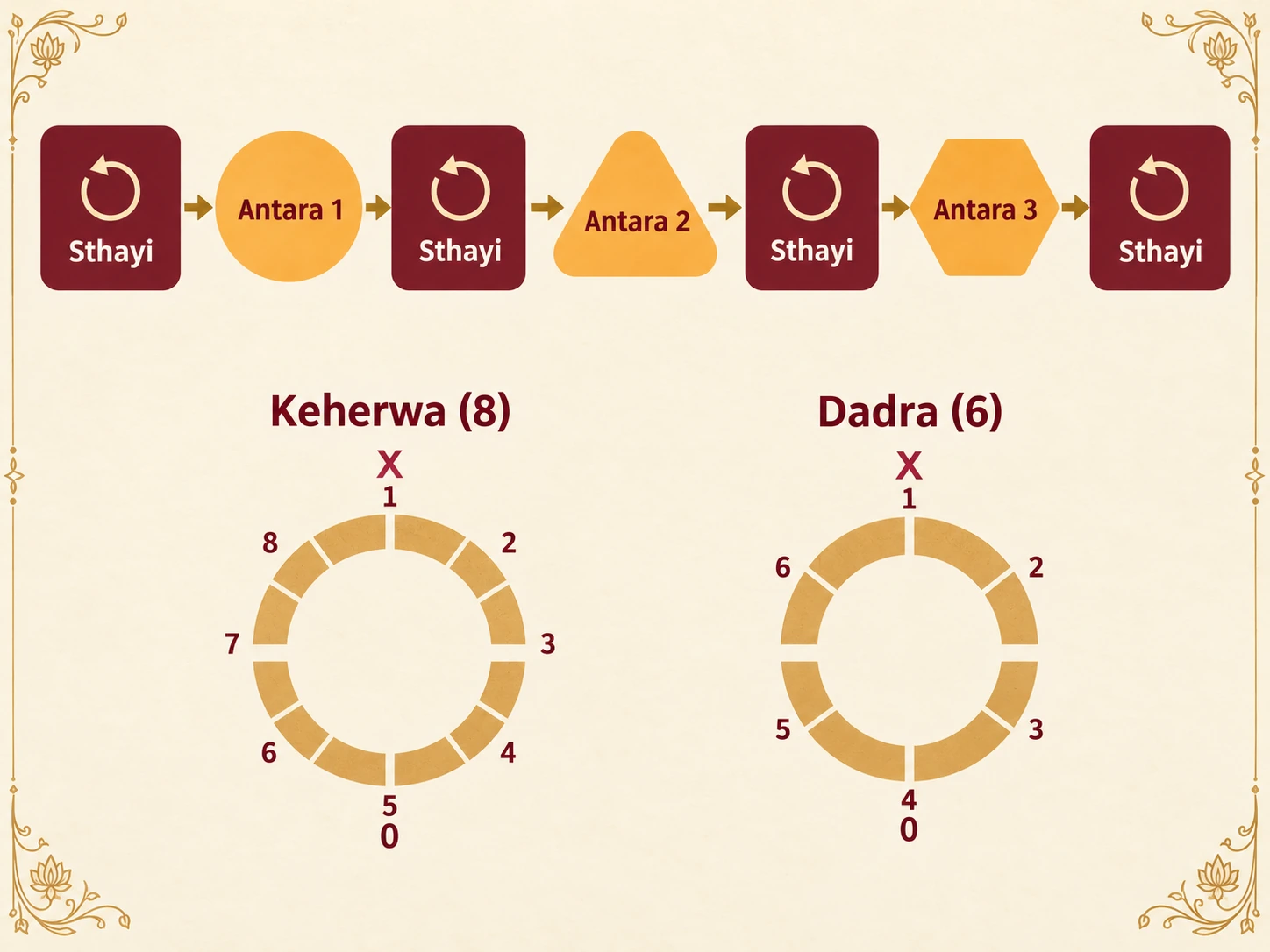
From level 2A bhajan has a refrain, the sthayi (also called mukhda or tek), and several verses, the antaras. After each antara the singer returns to the sthayi, so the refrain is heard many times.
| Feature | In a bhajan |
|---|---|
| Taal | mostly Keherwa (8) and Dadra (6); also Roopak and Deepchandi |
| Laya | madhya, often speeding up toward the end |
| Ornaments | meend, murki, short taans, used lightly |
| Elaboration | brief alaap or sargam between verses, never at the cost of the words |
| Accompaniment | harmonium, tabla or dholak, manjira or kartal |
Compare the khayal, where the words are few and the raga development is the point. In a bhajan the text is the point, and the music serves it.
Bhajan in the ABGMVM syllabus
From level 3| Level | What is asked |
|---|---|
| Praveshika Pratham | one bhajan, as one of the extra compositions; in the exam it may be one of three chosen from lakshan geet, bhajan, sargam geet and others |
| Praveshika Dwitiya | the Mandal prayer "Jai Jagdish Hare", plus one bhajan and one folk song; bhajan is also a song form in the theory paper |
| Madhyama Pratham | a bhajan, folk song or dhun |
| Madhyama Dwitiya | "Jai Jagdish Hare" again, with one bhajan, one ghazal, one patriotic song and one folk song |
| Alankar | a bhajan may be offered as the semi-classical item, alongside thumri |
Learn the Mandal prayer exactly as your centre teaches it: the same words and tune are sung across Mandal centres.
How to practise it, and what the examiner listens for
From level 2Practise
- Read the words and learn what they mean. You cannot convey a feeling you do not understand.
- Practise the pronunciation of the poem's language, whether Braj, Awadhi, Rajasthani or Marathi.
- Sing with the taal and return to the sthayi cleanly after each antara.
- If the tune is raga-based, keep its notes clean; light ornaments should decorate, not distract.
The examiner listens for
- clear, correctly pronounced words;
- good sur and steady laya;
- sincere bhava without exaggeration;
- a confident return to the refrain.
Exam questions
Answer these the way the examiner expects: short and exact.
What is a bhajan? Level 2
A devotional song in light classical style, with a refrain (sthayi) and several verses (antaras).
In which taals are bhajans usually sung? Level 2
Keherwa and Dadra.
Name three poet-saints whose bhajans are sung today. Level 3
Any three of Meera, Kabir, Surdas, Tulsidas, Narsinh Mehta and Sant Tukaram.
What is the prayer of the Mandal? Level 3
"Jai Jagdish Hare".
How does a bhajan differ from a khayal? Level 3
In a bhajan the words and devotion lead, in light classical style; in a khayal the raga is developed in depth through alaap and taan.
Related
- Vocal forms
- Khayal
Learning this with a teacher
These pages will take you a long way on theory. The singing needs a guru — live online classes, one level at a time, with exam preparation built in.