Raga
राग
In short
A distinctive arrangement of swaras and melodic movements that delights the listener is called a raga.
स्वरों और वर्णों से सजी वह विशेष स्वर-रचना जो सुनने वालों के मन को रंजित करे, राग कहलाती है।
What makes a raga
From level 2A scale is only a set of notes. A raga is a set of notes with rules about how to move through them: which notes rise, which fall, which are stressed, which phrases belong to it, and what mood it carries. Two ragas can share the same notes and still sound completely different.
The classical definition, from Matanga's Brihaddeshi:
योऽयं ध्वनिविशेषस्तु स्वरवर्णविभूषितः। रंजको जनचित्तानां स रागः कथितो बुधैः॥
"That particular arrangement of sound, adorned with swaras and varnas, which delights the minds of people, is called a raga by the learned." The key word is ranjak: a raga must please.
Describing a raga in the exam
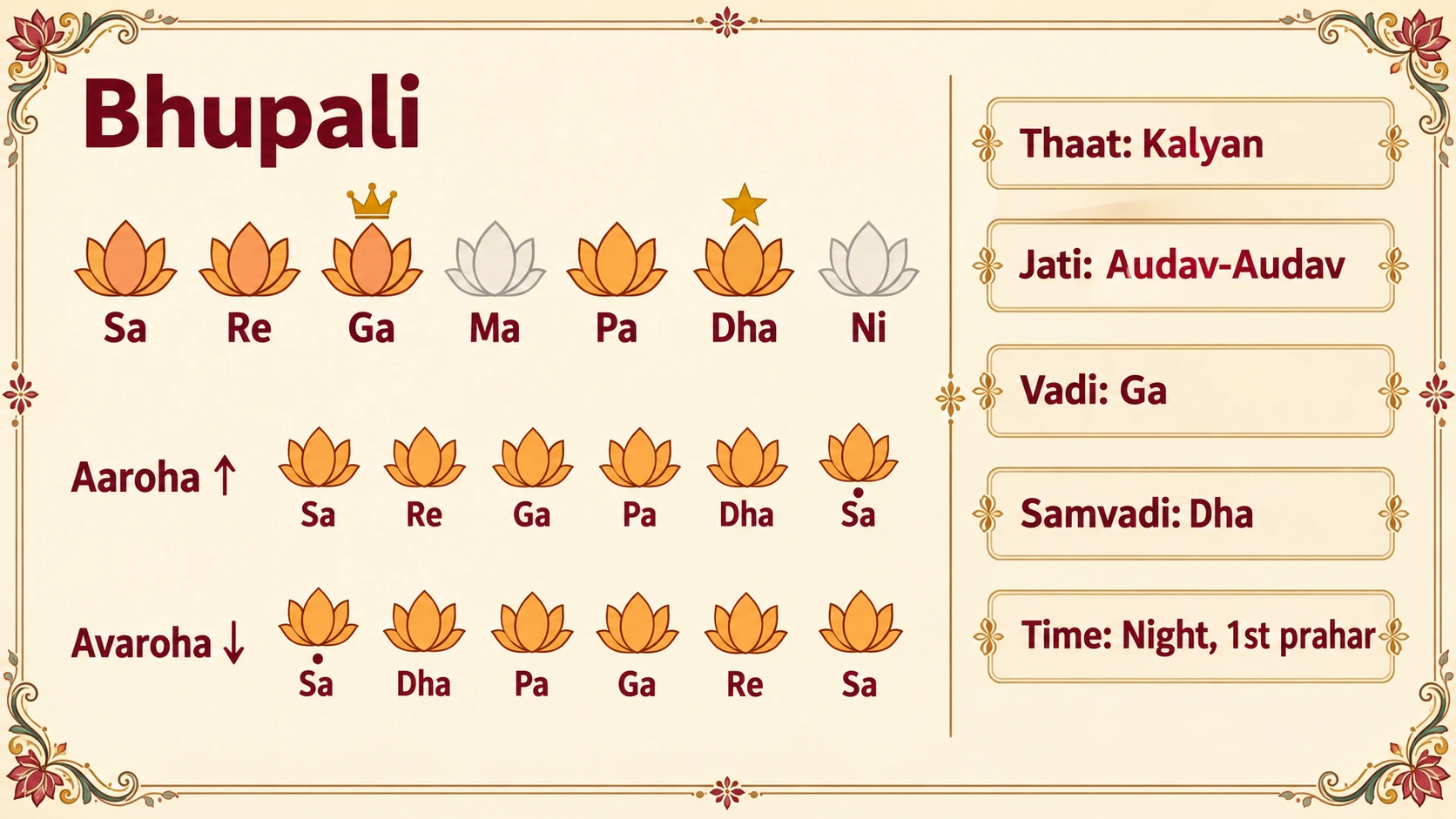
From level 1From Prarambhik onward the oral theory asks for a raga's description. Learn every syllabus raga in this order:
| Item | Bhupali, as an example |
|---|---|
| Thaat | Kalyan |
| Jati (level 2) | audav-audav |
| Varjit swaras | म and नि |
| Vadi / samvadi | ग / ध |
| Time | first prahar of the night |
| Aaroha | सा रे ग प ध सां |
| Avaroha | सां ध प ग रे सा |
| Pakad (level 2) | ग रे सा ध़, सा रे ग, प ग, ध प ग, रे सा |
Say it as a short, confident list. Examiners listen for the thaat, the vadi-samvadi and a correctly sung aaroha-avaroha before anything else.
Rules of a raga
From level 4- A raga must be born from a thaat.
- It must have at least five swaras. (Fewer than five cannot make a raga.)
- सा is never omitted.
- म and प are never both omitted; at least one must be present.
- It must have an aaroha and avaroha, a vadi and samvadi, a pakad and a time of performance.
- As a general rule, two forms of the same swara are not used one directly after the other. A few ragas, such as Lalit with its two Ma's, are accepted exceptions.
- Above all, it must have ranjakta: it must please the listener.
Shuddha, chhayalag and sankirna ragas
From level 3This is an old way of classifying ragas by how "pure" their identity is.
| Type | Meaning | Example |
|---|---|---|
| Shuddha (शुद्ध) | stands entirely on its own; shows no shade of any other raga | Yaman, Bhupali |
| Chhayalag (छायालग) | carries a shade (छाया) of one other raga within it | Chhayanat, which shows a shade of Nat |
| Sankirna (संकीर्ण) | a mixture of two or more ragas | Pilu |
Do not confuse this "shuddha" with shuddha swara. A shuddha raga can use komal or tivra notes; here the word means the raga's identity is unmixed.
Raga and thaat compared
From level 4| Thaat | Raga |
|---|---|
| always exactly seven swaras | at least five swaras |
| only an aaroha | both aaroha and avaroha |
| swaras strictly in order | swaras may move in a winding (vakra) way |
| not sung; ranjakta not needed | sung; ranjakta essential |
| no vadi, samvadi, pakad or time | has vadi, samvadi, pakad and time |
| the parent (janak) | the child (janya) |
In one line: a thaat is a set of notes; a raga is a way of singing them.
Exam questions
Answer these the way the examiner expects: short and exact.
Define raga. Level 2
A distinctive arrangement of swaras and varnas, born from a thaat, that pleases the listener (ranjakta).
What is the minimum number of swaras in a raga? Level 2
Five.
Which swara can never be omitted from a raga? Level 4
सा (Shadja).
What is a sankirna raga? Give an example. Level 3
A raga formed by mixing two or more ragas. Example: Pilu.
Give two differences between a raga and a thaat. Level 4
A thaat has exactly seven notes and only an aaroha; a raga has at least five notes and both aaroha and avaroha. A thaat is not sung, while a raga must have ranjakta.
Related
Learning this with a teacher
These pages will take you a long way on theory. The singing needs a guru — live online classes, one level at a time, with exam preparation built in.