Jati
जाति
In short
Jati states how many notes a raga uses in its ascent and descent: audav (5), shadav (6) or sampurna (7).
जाति बताती है कि राग के आरोह और अवरोह में कितने स्वर लगते हैं: औडव (5), षाडव (6) अथवा सम्पूर्ण (7)।
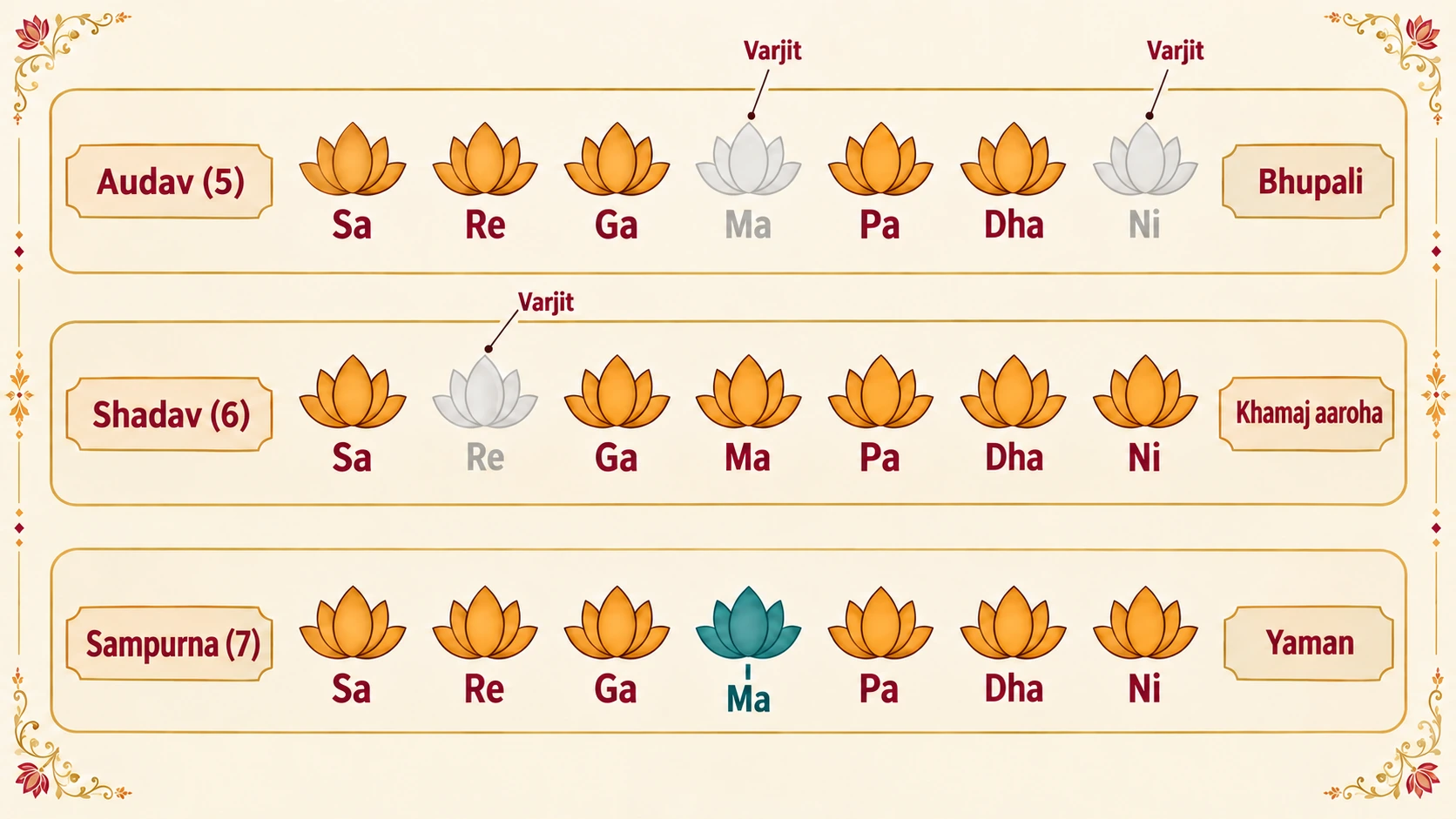
Varjit swaras
From level 1A varjit (वर्जित, forbidden) swara is a note a particular raga never uses. Sounding it breaks the raga. In Bhupali, म and नि are varjit; in Durga, ग and नि are varjit.
Varjit is not the same as vikrit. A vikrit note is altered (komal or tivra) but still sung; a varjit note is left out entirely. The Prarambhik oral asks for both: "what are the vikrit and varjit swaras of this raga?"
Audav, shadav, sampurna
From level 2Counting the swaras a raga uses gives its jati:
| Jati | Number of swaras | Varjit swaras |
|---|---|---|
| Audav (औडव) | 5 | 2 |
| Shadav (षाडव) | 6 | 1 |
| Sampurna (सम्पूर्ण) | 7 | none |
The count is made separately for the aaroha and the avaroha, so a raga's jati is always written as a pair: aaroha jati first, avaroha jati second.
The nine combinations
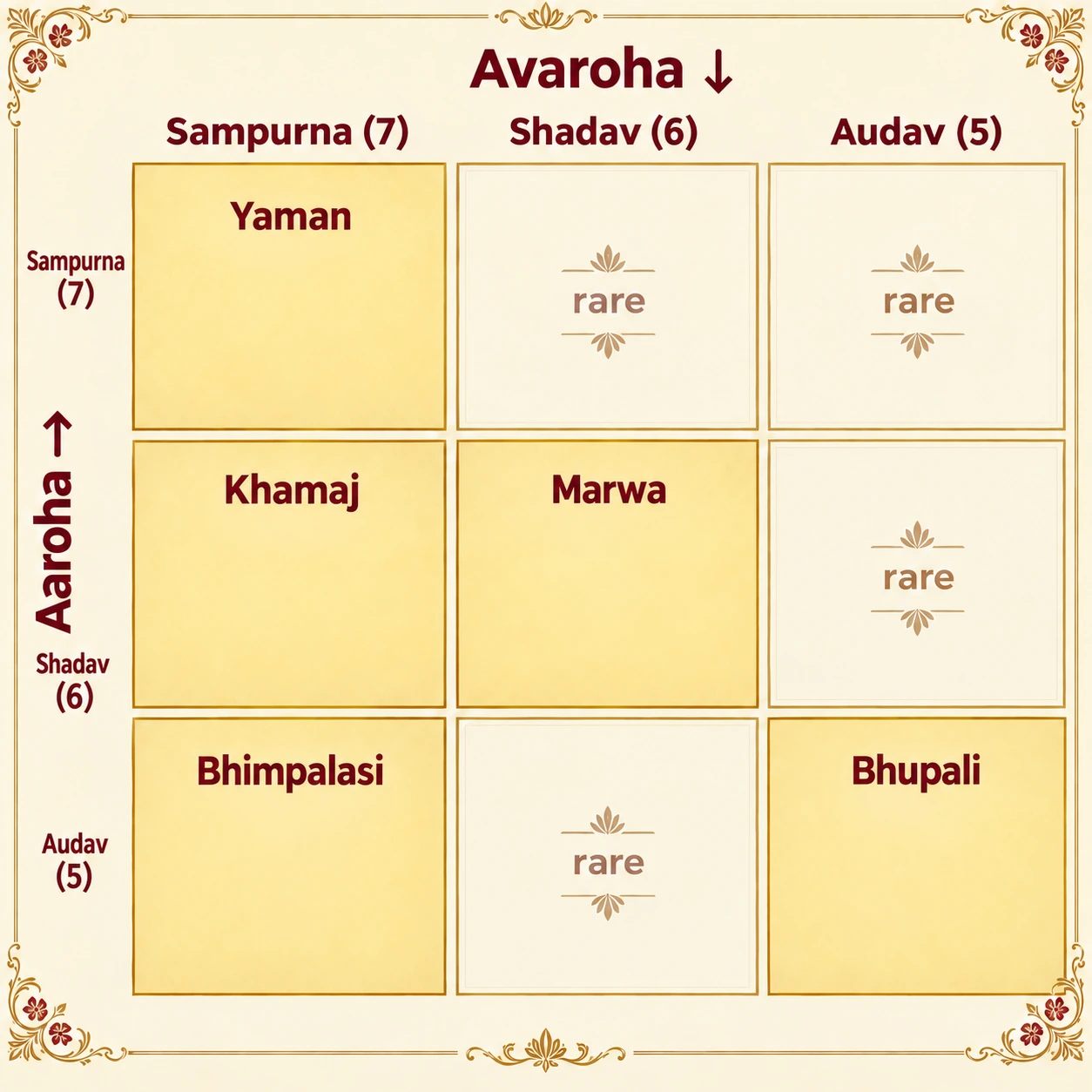
From level 2Three possible counts going up × three coming down = nine jatis.
| Aaroha | Avaroha | Jati | Example |
|---|---|---|---|
| 7 | 7 | sampurna-sampurna | Yaman, Kafi, Bhairav |
| 7 | 6 | sampurna-shadav | rare |
| 7 | 5 | sampurna-audav | rare |
| 6 | 7 | shadav-sampurna | Khamaj, Alhaiya Bilawal |
| 6 | 6 | shadav-shadav | Marwa |
| 6 | 5 | shadav-audav | rare |
| 5 | 7 | audav-sampurna | Bhimpalasi, Bageshree, Des |
| 5 | 6 | audav-shadav | rare |
| 5 | 5 | audav-audav | Bhupali, Durga, Vrindavani Sarang |
To work out a jati yourself, count the different swaras in the aaroha (ignore taar सां, which is सा again), then do the same for the avaroha. Khamaj rises सा ग म प ध नि सां (six: रे is left out) and falls through all seven, so it is shadav-sampurna.
How many ragas can one thaat produce?
From level 4The level 4 paper asks for the classification of ragas by number of notes and its arithmetic. With सा always present, choose which of the other six notes to drop:
- sampurna: drop none: 1 way
- shadav: drop one of six: 6 ways
- audav: drop two of six: 15 ways
That gives 1 + 6 + 15 = 22 possible aarohas, and likewise 22 avarohas. So one thaat can, in theory, produce 22 × 22 = 484 ragas, and 32 thaats give 32 × 484 = 15,488. This is the classic textbook figure; the rule that म and प are not both dropped would reduce it slightly, and in practice only a small fraction of these are real ragas.
Exam questions
Answer these the way the examiner expects: short and exact.
What is jati? Level 2
The class of a raga by the number of swaras in its aaroha and avaroha: audav (5), shadav (6) or sampurna (7).
What is the jati of Bhupali? Level 2
Audav-audav: five swaras in both aaroha and avaroha (म and नि varjit).
What is the jati of Bhimpalasi? Level 2
Audav-sampurna.
What is a varjit swara? Level 1
A swara that is strictly not used in a particular raga. Example: म and नि in Bhupali.
How many jatis are possible? Level 2
Nine: three aaroha counts (5, 6, 7) combined with three avaroha counts.
Learning this with a teacher
These pages will take you a long way on theory. The singing needs a guru — live online classes, one level at a time, with exam preparation built in.