Aaroha and Avaroha
आरोह-अवरोह
In short
Aaroha: the ascending order of notes, moving from low to high. Avaroha: the descending order of notes, coming from high to low.
आरोह: स्वरों का आरोही क्रम, नीचे से ऊपर की ओर चढ़ना। अवरोह: स्वरों का अवरोही क्रम, ऊपर से नीचे की ओर उतरना।
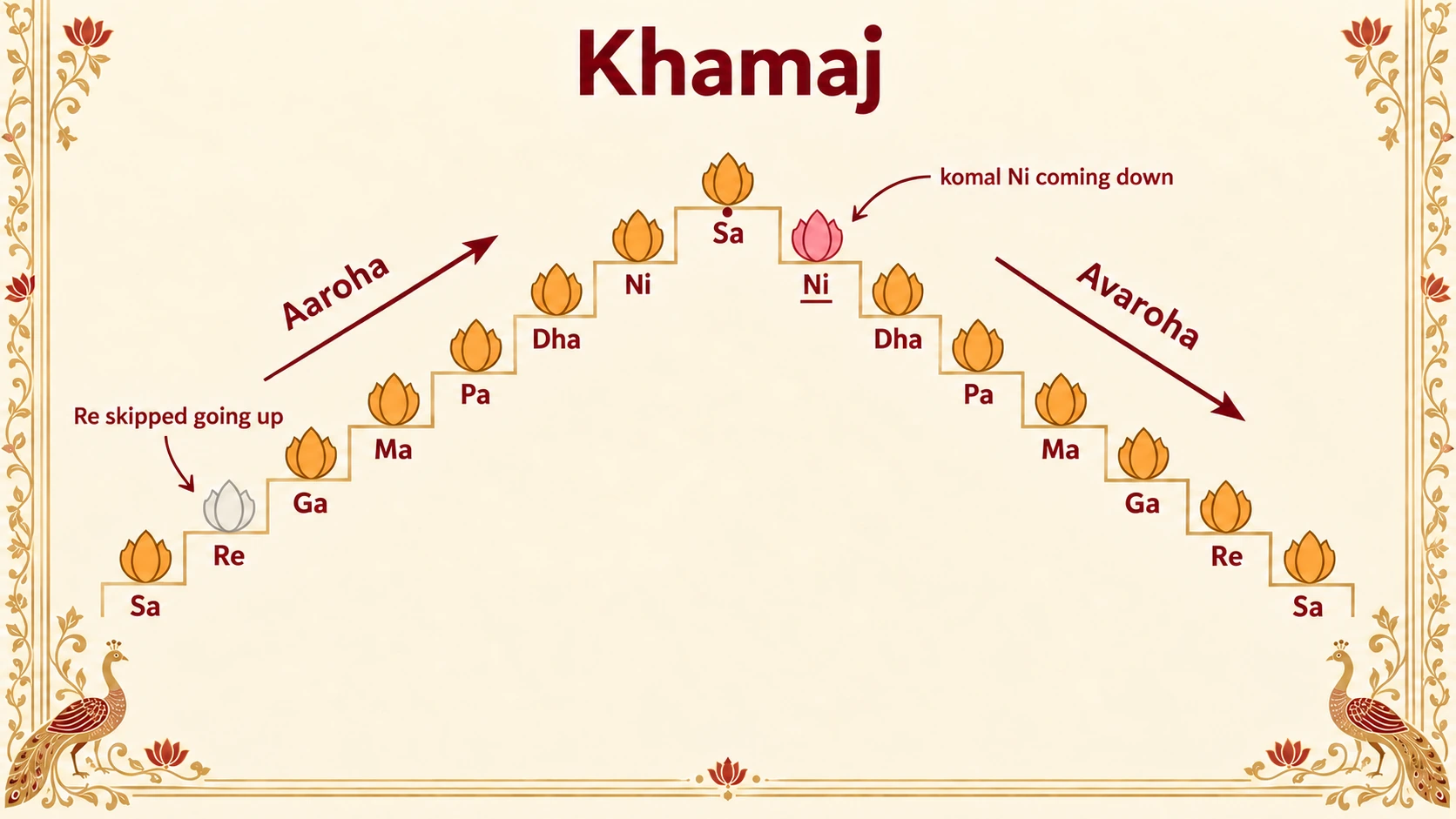
Aaroha and avaroha
From level 1The aaroha (आरोह) is how a raga climbs from सा to taar सां; the avaroha (अवरोह) is how it comes back down. They are not just a scale up and down: they show which notes a raga uses in each direction, and the two can differ.
| Raga | Aaroha | Avaroha |
|---|---|---|
| Bhupali | सा रे ग प ध सां | सां ध प ग रे सा |
| Khamaj | सा ग म प ध नि सां | सां नि॒ ध प म ग रे सा |
| Bhimpalasi | नि़॒ सा ग॒ म प नि॒ सां | सां नि॒ ध प म ग॒ रे सा |
Khamaj rises with shuddha नि and leaves out रे, but descends with komal नि and uses रे. Bhimpalasi skips रे and ध going up but uses all seven coming down. Learning these differences is learning the raga.
Pakad and the main phrases
From level 1The pakad (पकड़, "catch") is a short group of notes that immediately identifies a raga. Bhupali's pakad:
ग रे सा ध़, सा रे ग, प ग, ध प ग, रे सा
Level 2 also asks for each raga's mukhya swar samudaya (मुख्य स्वरसमुदाय) or mukhya ang: the characteristic phrases, beyond the pakad, that keep appearing in the raga. In Bhupali, the descent ध प ग and the rest on ग are such phrases.
In the practical you will be asked to recognise a raga from a few notes. Sing every syllabus raga's pakad daily until hearing three or four of its notes brings the name to mind.
Poorvang and uttarang
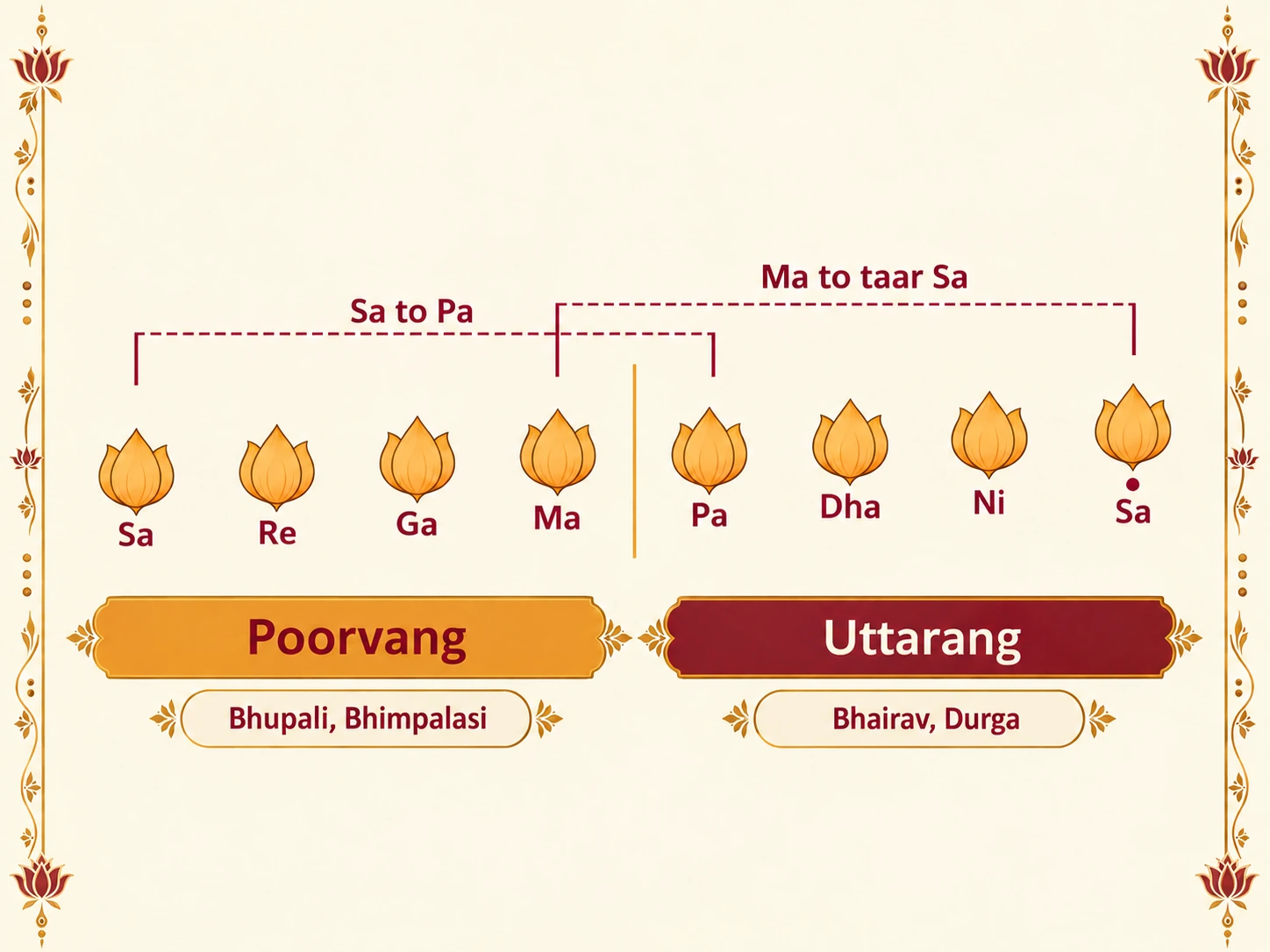
From level 3The saptak is split into two halves.
| Half | Swaras |
|---|---|
| Poorvang (पूर्वांग, first part) | सा रे ग म |
| Uttarang (उत्तरांग, latter part) | प ध नि सां |
A raga is called poorvang-pradhan if its movement and vadi sit mainly in the lower half (Bhupali, Bhimpalasi) and uttarang-pradhan if they sit mainly in the upper half (Bhairav, Durga). For the vadi-and-time rule, many textbooks stretch the halves to सा to प and म to सां, so that म and प belong to both.
Vakra swaras
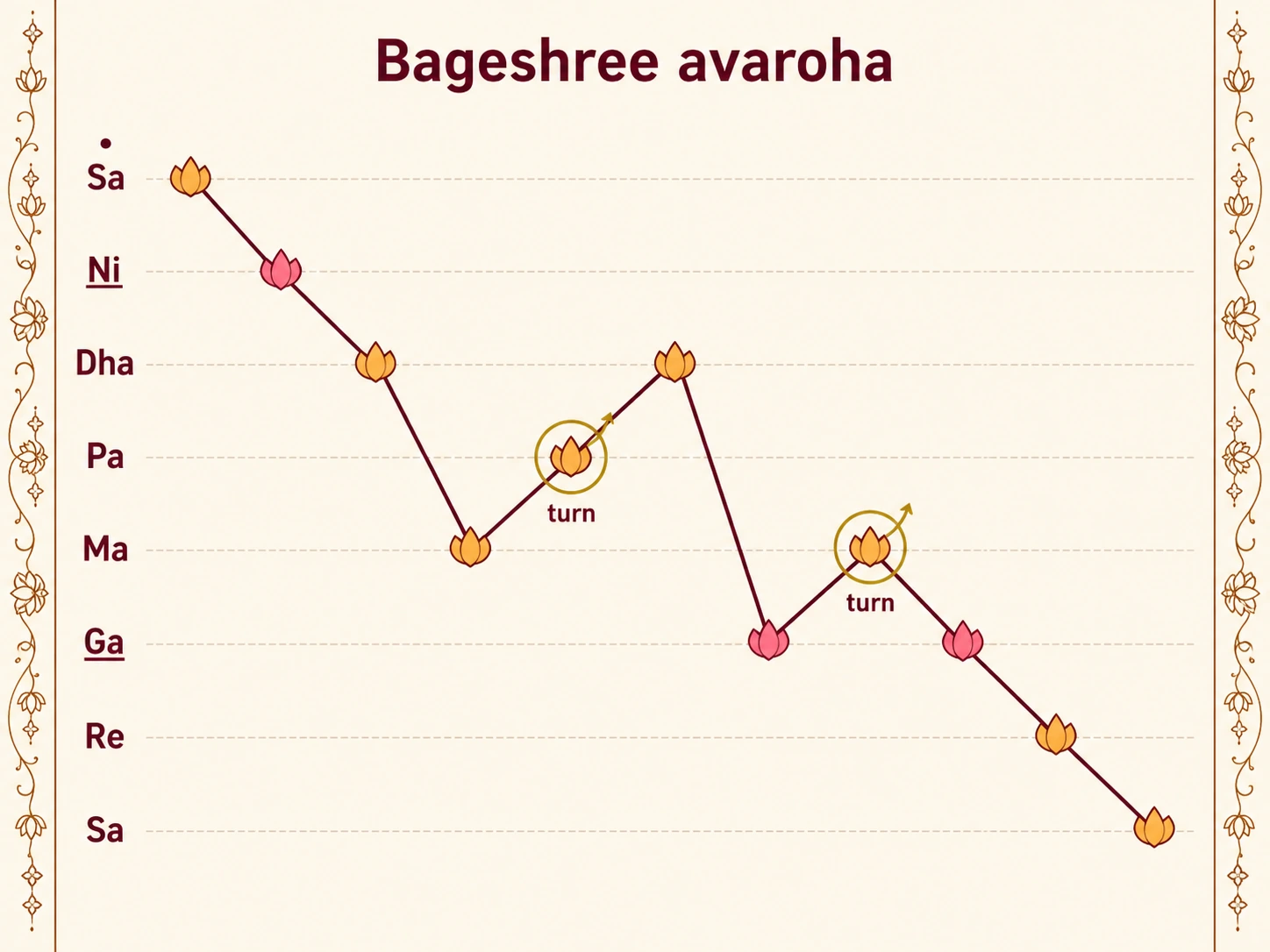
From level 3Most ragas move in a straight line up or down. In some, a note is approached with a turn: the melody goes past it and comes back, or doubles back before continuing. Such a note is vakra (वक्र, crooked), and the raga is said to have a vakra chalan.
Bageshree's avaroha is a clear example:
सां नि॒ ध, म प ध ग॒, म ग॒ रे सा
Instead of falling straight from ध to प, the line drops to म, climbs back through प ध, then drops to ग॒ and turns again. Singing that turn correctly is what makes it Bageshree and not Kafi.
Chalan and uthaav
From level 4At Madhyama you must explain three related terms.
- Pakad: the short identifying phrase (see above).
- Chalan (चलन, "movement"): the overall way a raga moves through its notes: which notes it lingers on, where it turns, which phrases it repeats. Two ragas with the same aaroha-avaroha can differ completely in chalan.
- Uthaav (उठाव, "lift"): the characteristic way a raga's development opens, the phrase with which an alaap or a bandish usually begins.
The pakad is a sentence; the chalan is the grammar of the whole language.
Exam questions
Answer these the way the examiner expects: short and exact.
Sing and write the aaroha and avaroha of Bhupali. Level 1
Aaroha: सा रे ग प ध सां. Avaroha: सां ध प ग रे सा.
What is a pakad? Level 1
The short group of notes by which a raga is recognised.
What are poorvang and uttarang? Level 3
The two halves of the saptak: poorvang सा रे ग म, uttarang प ध नि सां.
What is a vakra swara? Level 3
A note approached with a turn rather than in straight order, as in Bageshree: म प ध ग॒, म ग॒ रे सा.
What is chalan? Level 4
The characteristic overall movement of a raga through its notes, its phrases, turns and resting points.
Related
Learning this with a teacher
These pages will take you a long way on theory. The singing needs a guru — live online classes, one level at a time, with exam preparation built in.