Vadi and Samvadi
वादी-संवादी
In short
Vadi: the most important note of a raga, sounded repeatedly and given the most weight. It is called the king of the raga. Samvadi: the second most important note, which supports the vadi, the minister to its king.
वादी: राग का सबसे महत्त्वपूर्ण स्वर, जिसे बार-बार और सबसे अधिक बल देकर लगाया जाता है। इसे राग का राजा कहते हैं। संवादी: राग का दूसरा महत्त्वपूर्ण स्वर, जो वादी स्वर का साथ देता है; राग का मंत्री।
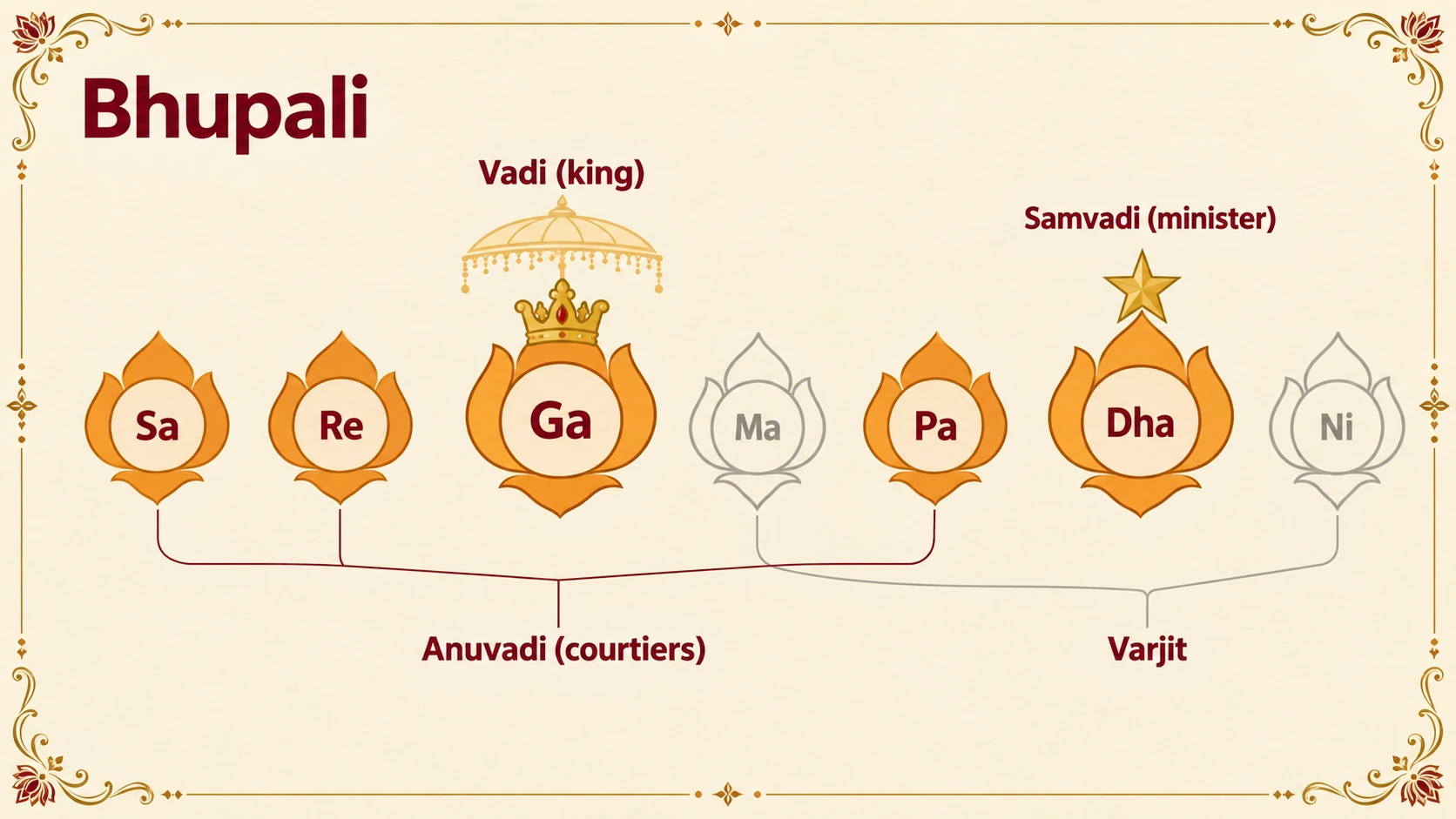
Vadi and samvadi
From level 1Not all notes of a raga are equal. The vadi (वादी) is the one the raga keeps returning to and resting on; the samvadi (संवादी) is its partner, used with the next greatest weight. The traditional image is a court: the vadi is the king, the samvadi the minister.
| Raga | Vadi | Samvadi |
|---|---|---|
| Bhupali | ग | ध |
| Durga | ध | रे |
| Kafi | प | सा |
| Bhimpalasi | म | सा |
| Bageshree | म | सा |
| Khamaj | ग | नि |
| Des | रे | प |
When you sing alaap, let the vadi be the note you sustain longest and land on most often. It is one of the quickest ways an examiner hears that you know the raga.
Anuvadi and vivadi
From level 2- Anuvadi (अनुवादी): all the remaining notes of the raga, neither vadi nor samvadi. In the court image, the servants or courtiers.
- Vivadi (विवादी): a note that clashes with the raga, the enemy. It is normally avoided, though a skilled singer may touch it for a moment to add beauty. Until your teacher shows you such a use, simply do not sing it.
Vivadi is not the same as varjit. A varjit note is never used at all; a vivadi note is foreign to the raga but may, very rarely and with great care, be brushed in passing.
Graha, amsha and nyaas
From level 3Three older terms describe where a raga's melody begins, centres and comes to rest.
| Term | Meaning | Today |
|---|---|---|
| Graha (ग्रह) | the swara on which a raga's melody or song begins | the note an alaap or bandish starts from |
| Amsha (अंश) | the swara that is most prominent and gives the raga its character | treated as practically the same as the vadi |
| Nyaas (न्यास) | the swara on which a phrase or the whole performance comes to rest | the resting notes where phrases end |
In Bhupali, many phrases come to rest on ग or on सा: those are its nyaas swaras.
How the vadi relates to the raga
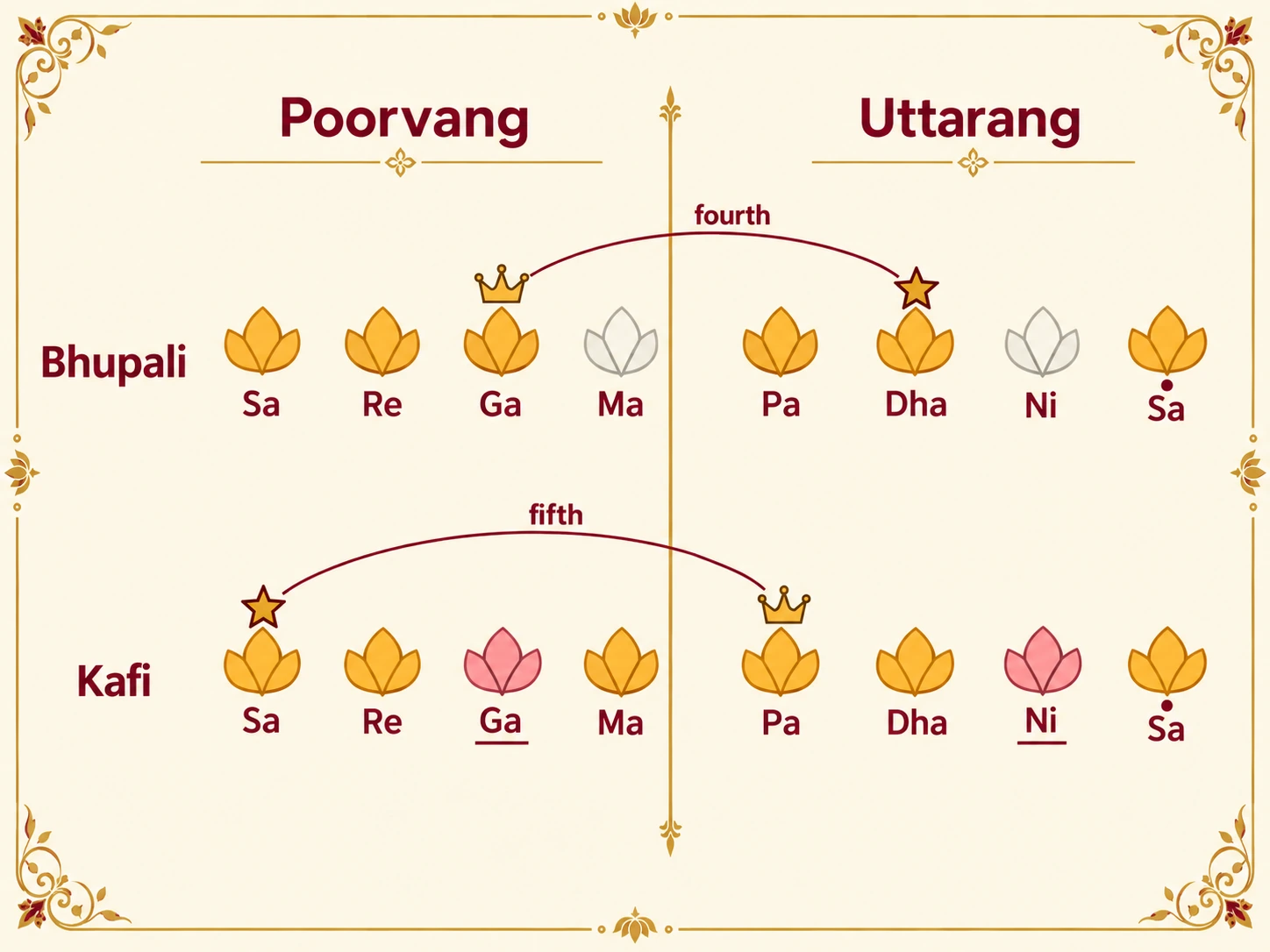
From level 4Interval. The samvadi is normally a fourth or a fifth away from the vadi: the relationship of सा to म (षड्ज-मध्यम भाव) or सा to प (षड्ज-पंचम भाव). Bhupali's ग to ध and Des's रे to प are both fourths; Kafi's सा and प are a fifth apart.
Halves of the saptak. Because of that interval, if the vadi is in the lower half (poorvang: सा रे ग म), the samvadi is in the upper half (uttarang: प ध नि सां), and the other way round.
Time. A raga whose vadi is in the poorvang is a poorva raga, usually sung between noon and midnight (Bhupali, Yaman). A raga whose vadi is in the uttarang is an uttar raga, usually sung between midnight and noon (Bhairav). There are exceptions; treat this as a guide, not a law.
Identity. The vadi can separate two ragas with the same notes: Bhupali (vadi ग) and Deshkar (vadi ध) share सा रे ग प ध, but the weight falls in opposite halves.
Exam questions
Answer these the way the examiner expects: short and exact.
What is the vadi of Bhupali? Level 1
ग (Gandhar). Its samvadi is ध (Dhaivat).
Define vadi. Level 2
The most important note of a raga, used most often and with the most weight; the king of the raga.
What is a vivadi swara? Level 2
A note that clashes with the raga and is normally avoided, though an expert may touch it briefly for beauty.
What do graha, amsha and nyaas mean? Level 3
Graha: the starting note. Amsha: the most prominent note (like the vadi). Nyaas: the note on which phrases come to rest.
What is the usual interval between vadi and samvadi? Level 4
A fourth or a fifth (षड्ज-मध्यम or षड्ज-पंचम भाव), so one is in the poorvang and the other in the uttarang.
Learning this with a teacher
These pages will take you a long way on theory. The singing needs a guru — live online classes, one level at a time, with exam preparation built in.