Raag Bhairav
राग भैरव
Bhairav thaat Also spelled: Bhairava
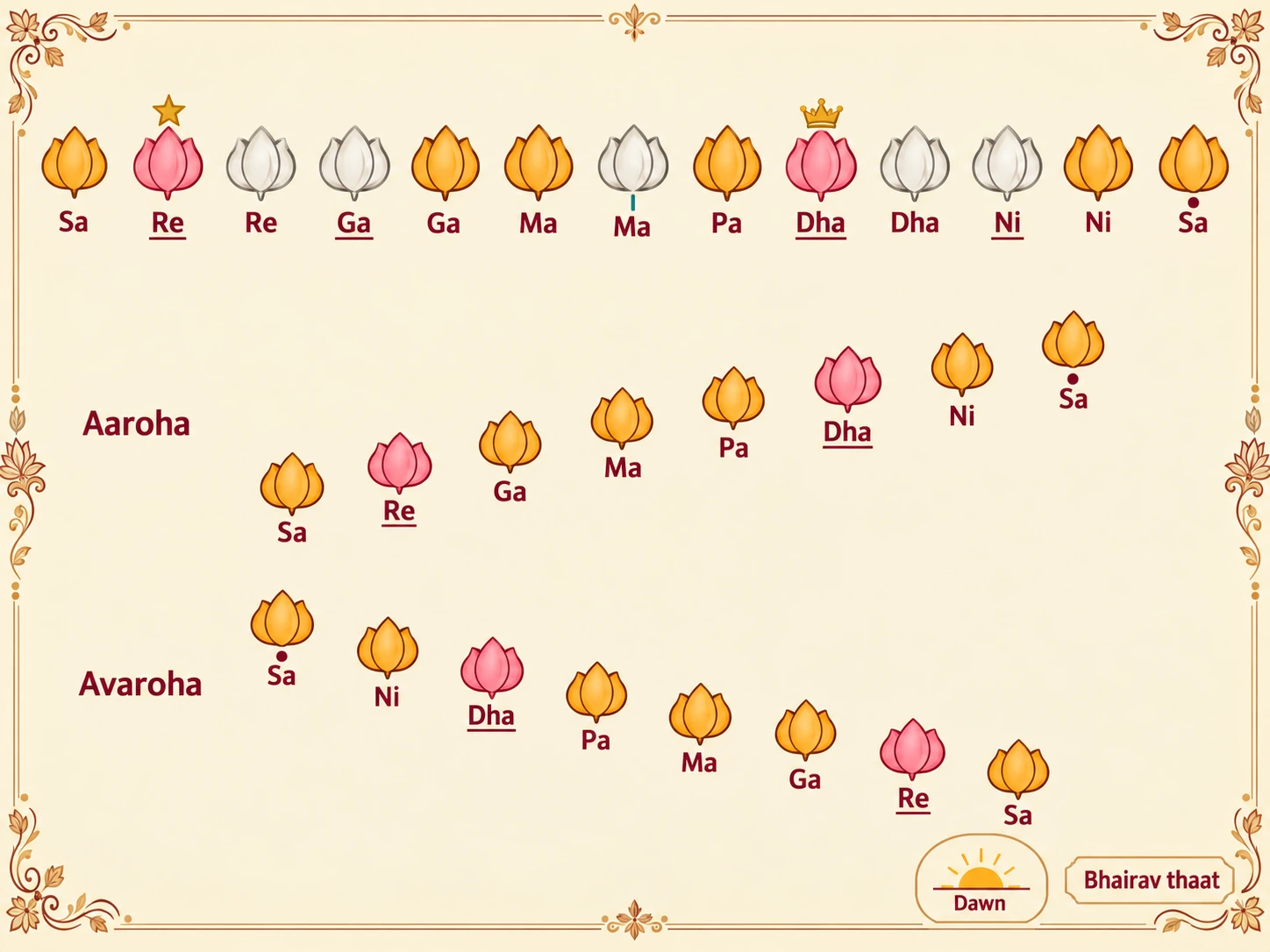
The parent raga of the thaat that carries its name, sung at dawn as a sandhiprakash (twilight) raga. The oscillating komal Re and Dha give it a grave, devotional weight.
- Thaat (parent scale)
- Bhairav
- Jati (type)
- Sampurna – Sampurna · 7 notes up, 7 down
- Vadi (king note)
- Komal Dha (Dhaivat)
- Samvadi (minister note)
- Komal Re (Rishabh)
- Time of singing
- Dawn (a sandhiprakash, or twilight, raga)
Scale and structure
Key rule: Komal Re and komal Dha, each sung with a slow oscillation (andolan). Every other note is natural.
Aaroha (ascent)
सा रे॒ ग म प ध॒ नि सां
Avaroha (descent)
सां नि ध॒ प म ग रे॒ सा
Pakad (catch phrase)
सा ग म प ध॒ ध॒ प, ग म रे॒ रे॒ सा
Sargam is given in Devanagari, as it is written in practice — a line beneath a note marks it komal (flat), and (मंद्र) marks the lower octave.
Learning this with a teacher
These pages will take you a long way on theory. The singing needs a guru — live online classes, one level at a time, with exam preparation built in.