Thaat (Mel)
थाट (मेल)
In short
The parent scale from which a raga draws its notes.
वह जनक स्वर-समूह जिससे राग के स्वर लिए जाते हैं।
What a thaat is
From level 1A thaat (also called mel) is a set of seven swaras, one form of each note, from which ragas are made. When you describe a raga in the exam, its thaat is the first thing you name: Bhupali belongs to Kalyan thaat, Bhimpalasi and Bageshree to Kafi thaat, Khamaj and Des to Khamaj thaat.
A thaat is a scale, not a tune. It tells you which notes are available; the raga decides how they are used.
Rules of a thaat
From level 4- A thaat must have seven swaras, no more and no fewer.
- The swaras must be in order: सा रे ग म प ध नि.
- A thaat has only an aaroha; no avaroha is needed.
- A thaat is not sung as music, so it does not need ranjakta (the quality of pleasing the listener).
- A thaat is named after a well-known raga born from it, such as Kalyan, Bhairav or Kafi.
Pt. Bhatkhande's ten thaats
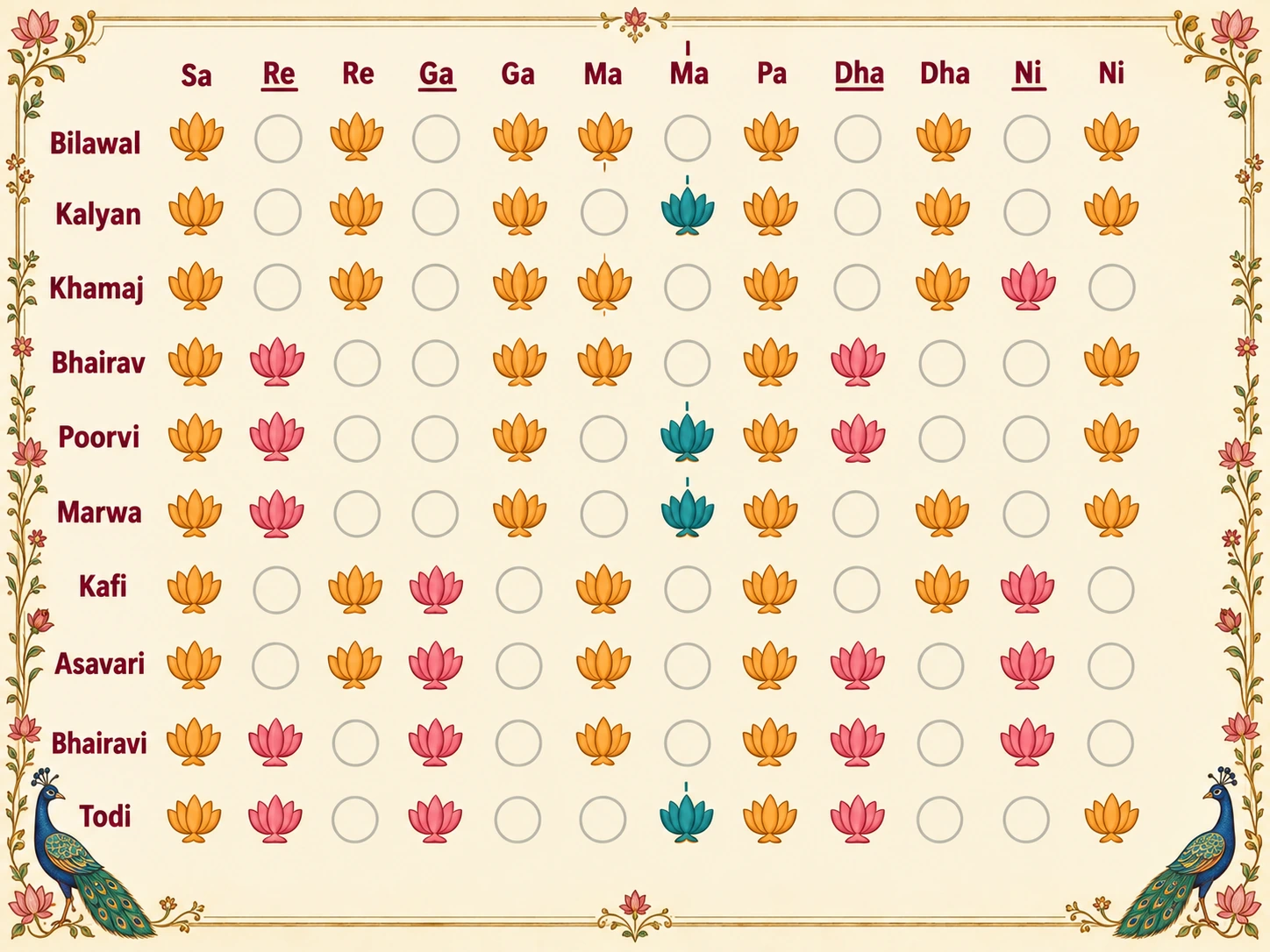
From level 4Pt. Vishnu Narayan Bhatkhande grouped Hindustani ragas under ten thaats. This is the system the ABGMVM syllabus uses.
| # | Thaat | Swaras | Vikrit swaras |
|---|---|---|---|
| 1 | Bilawal | सा रे ग म प ध नि | none (all shuddha) |
| 2 | Kalyan | सा रे ग म॑ प ध नि | tivra म |
| 3 | Khamaj | सा रे ग म प ध नि॒ | komal नि |
| 4 | Bhairav | सा रे॒ ग म प ध॒ नि | komal रे, ध |
| 5 | Poorvi | सा रे॒ ग म॑ प ध॒ नि | komal रे, ध; tivra म |
| 6 | Marwa | सा रे॒ ग म॑ प ध नि | komal रे; tivra म |
| 7 | Kafi | सा रे ग॒ म प ध नि॒ | komal ग, नि |
| 8 | Asavari | सा रे ग॒ म प ध॒ नि॒ | komal ग, ध, नि |
| 9 | Bhairavi | सा रे॒ ग॒ म प ध॒ नि॒ | komal रे, ग, ध, नि |
| 10 | Todi | सा रे॒ ग॒ म॑ प ध॒ नि | komal रे, ग, ध; tivra म |
A memory aid: only Kalyan, Poorvi, Marwa and Todi use tivra म; Bilawal is the one with no vikrit notes at all.
Janak and janya ragas
From level 3- Janak (जनक, parent): the thaat that gives a raga its notes.
- Janya (जन्य, born): a raga born from a thaat. Every raga is janya.
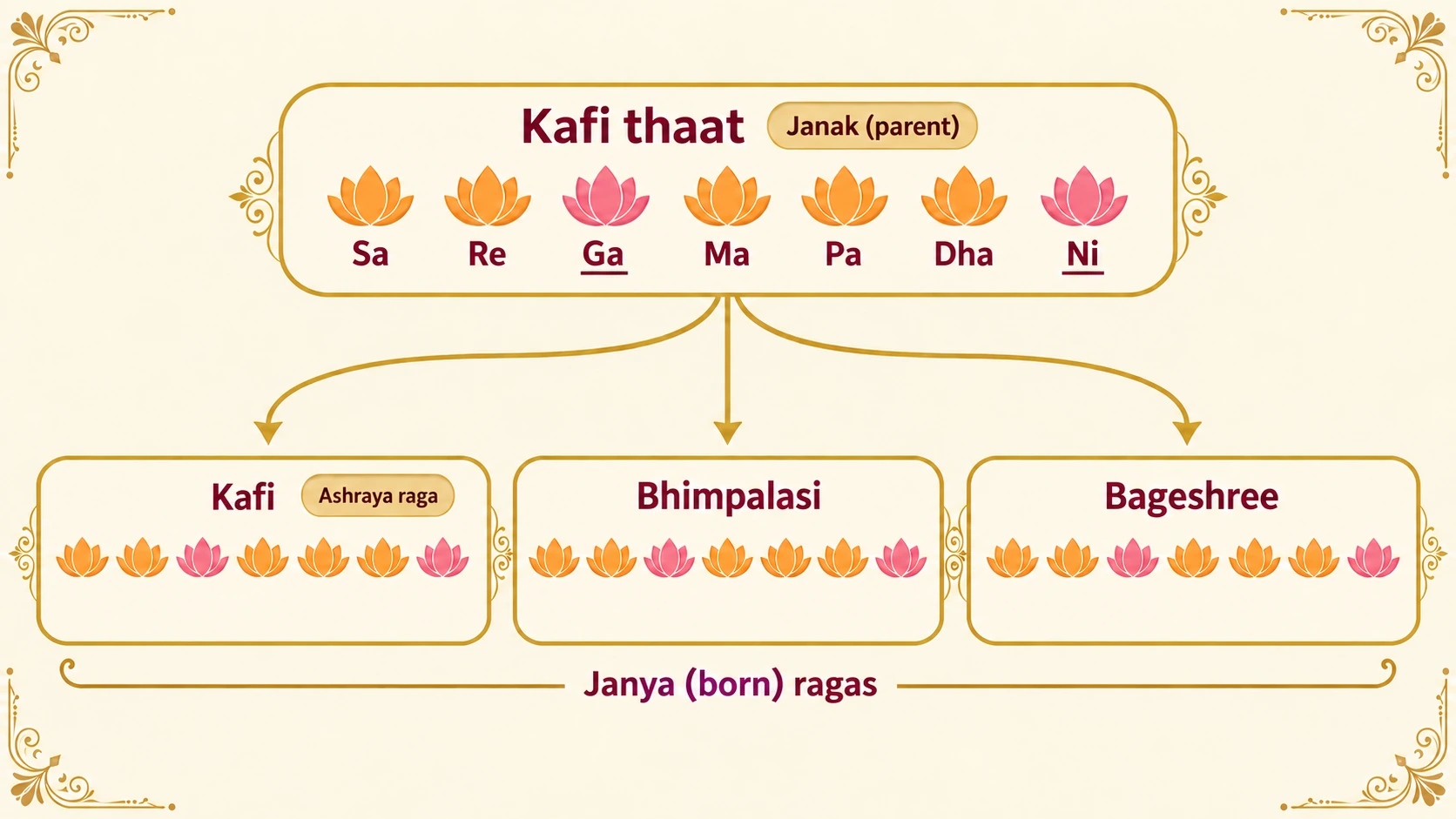
The raga whose name a thaat carries, and which shows the thaat's notes most fully, is called its ashraya raga (आश्रय राग). Yaman is the ashraya raga of Kalyan thaat, Kafi of Kafi thaat, Bhairav of Bhairav thaat.
One thaat gives birth to many ragas. From Kafi thaat come Kafi, Bhimpalasi and Bageshree, each using the same set of notes in a different way.
Why 32 thaats are possible
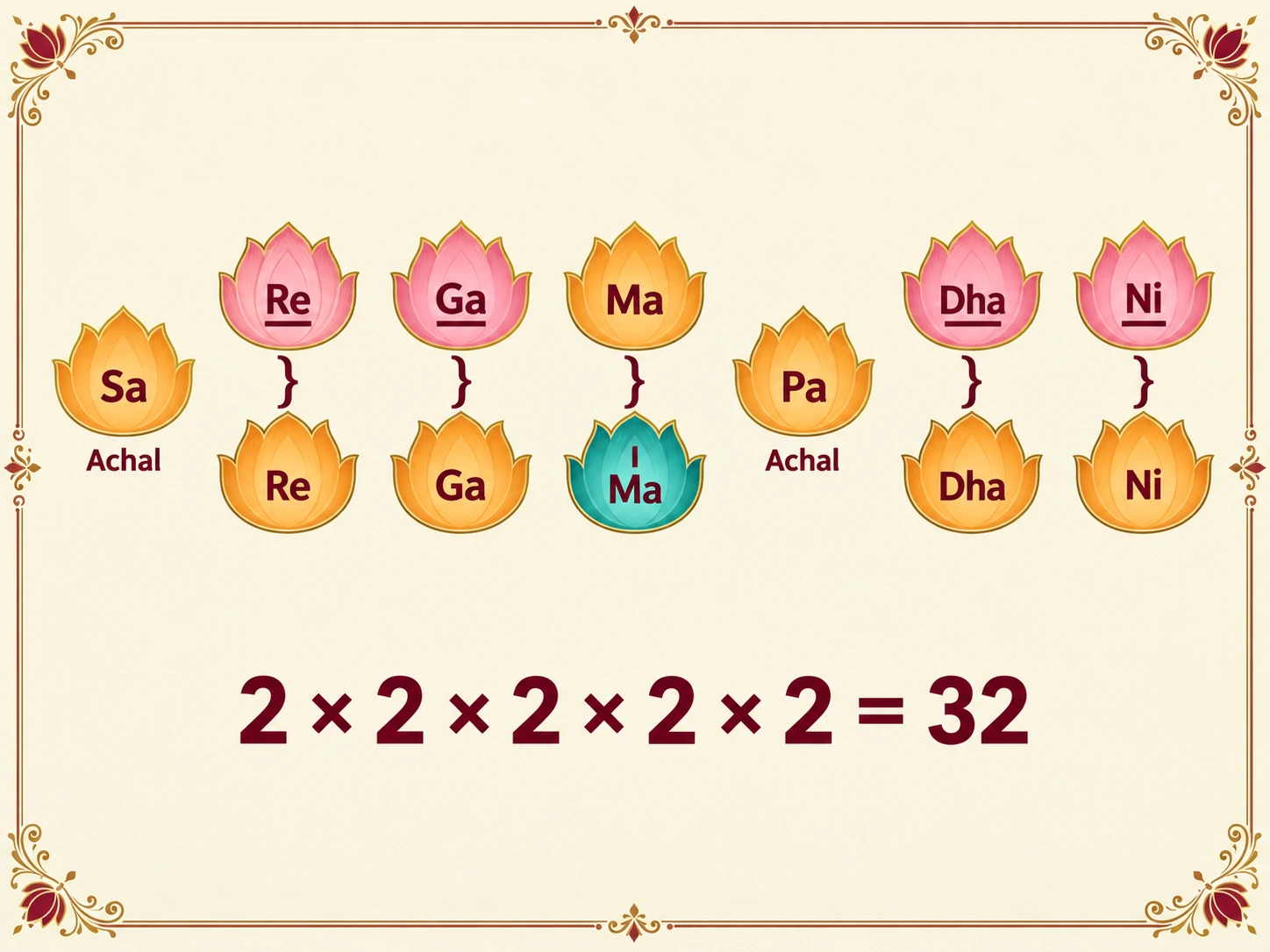
From level 4The syllabus asks how thaats are built mathematically. सा and प are achal, so they are always present. Each of the other five notes (रे ग म ध नि) has two forms, and a thaat takes exactly one of each:
2 × 2 × 2 × 2 × 2 = 32 possible thaats.
Pt. Bhatkhande chose ten of these 32 because they cover almost all ragas in current practice. (Carnatic music, which counts more note positions, arrives at 72 melakartas; see Hindustani and Carnatic.)
Exam questions
Answer these the way the examiner expects: short and exact.
What is a thaat? Level 2
The parent scale of seven swaras from which a raga draws its notes. It is also called mel.
What is the thaat of Bhupali? Of Bhimpalasi? Level 1
Bhupali: Kalyan thaat. Bhimpalasi: Kafi thaat.
What is the difference between a janak and a janya raga? Level 3
The janak is the parent thaat; a janya raga is a raga born from it.
Name the ten thaats of Pt. Bhatkhande. Level 4
Bilawal, Kalyan, Khamaj, Bhairav, Poorvi, Marwa, Kafi, Asavari, Bhairavi, Todi.
Which thaats use tivra Ma? Level 4
Kalyan, Poorvi, Marwa and Todi.
How many thaats are mathematically possible, and why? Level 4
- सा and प are fixed, and each of रे ग म ध नि has two forms: 2⁵ = 32.
Learning this with a teacher
These pages will take you a long way on theory. The singing needs a guru — live online classes, one level at a time, with exam preparation built in.