Hindustani and Carnatic
हिंदुस्तानी और कर्नाटक संगीत
In short
Indian classical music has two main systems: North Indian (Hindustani) and South Indian (Carnatic).
भारतीय शास्त्रीय संगीत की दो मुख्य पद्धतियाँ हैं: उत्तर भारतीय (हिंदुस्तानी) और दक्षिण भारतीय (कर्नाटक)।
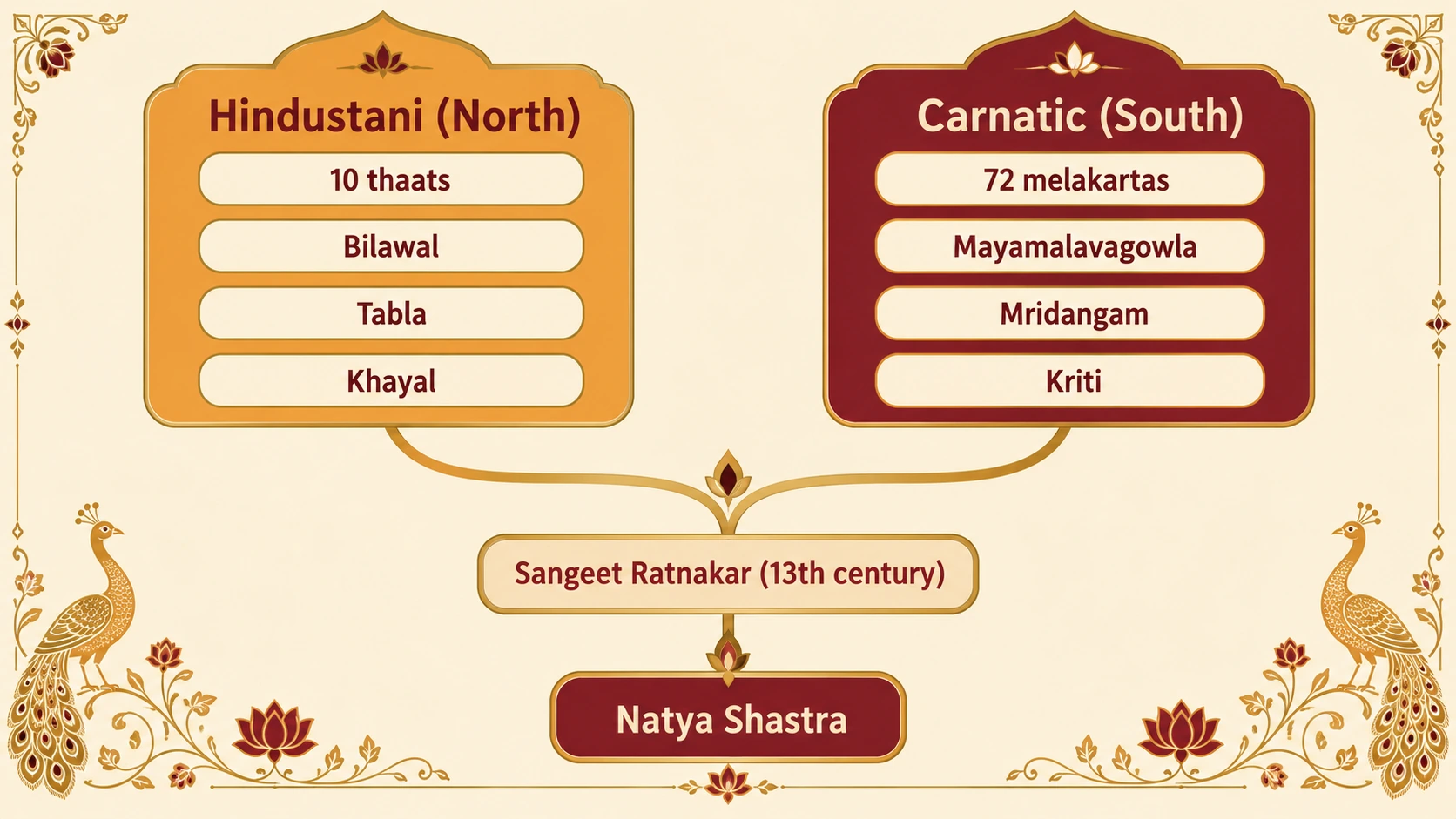
Two systems from one root
From level 3Indian classical music shares one ancient root: the Natya Shastra and the older texts that follow it. Sharngadeva's Sangeet Ratnakar (13th century) is usually taken as the last major text both traditions claim. After that the music of the north and the south developed separately, into Hindustani (North Indian) and Carnatic (South Indian, कर्नाटक) music.
Both are built on the same ideas: swara, raga, taal, the drone of the tanpura, improvisation within strict rules. What differs is how those ideas are organised and performed.
The main differences
From level 3| Hindustani | Carnatic | |
|---|---|---|
| Region | North, central, east and west India; also Pakistan, Nepal, Bangladesh | South India: Tamil Nadu, Karnataka, Andhra Pradesh, Telangana, Kerala |
| Scale system | 10 thaats (Pt. Bhatkhande) | 72 melakartas (Venkatamakhi) |
| First scale taught | Bilawal (all shuddha) | Mayamalavagowla (the notes of Bhairav thaat) |
| Rhythm | taal shown by claps and waves; theka on tabla or pakhawaj | tala counted with claps, waves and finger counts; mridangam |
| Main vocal forms | dhrupad, dhamar, khayal, tarana, thumri, bhajan | varnam, kriti, kirtanam, tillana, ragam-tanam-pallavi |
| Improvisation | alaap, taan, bol-alaap, laykari | alapana, kalpana swaras, niraval |
| Ornament | used selectively (meend, kan, murki, gamak) | gamakas on almost every note |
| Key figures | Tansen, Sadarang, Bhatkhande, Paluskar | Purandara Dasa; the Trinity: Tyagaraja, Muthuswami Dikshitar, Syama Shastri |
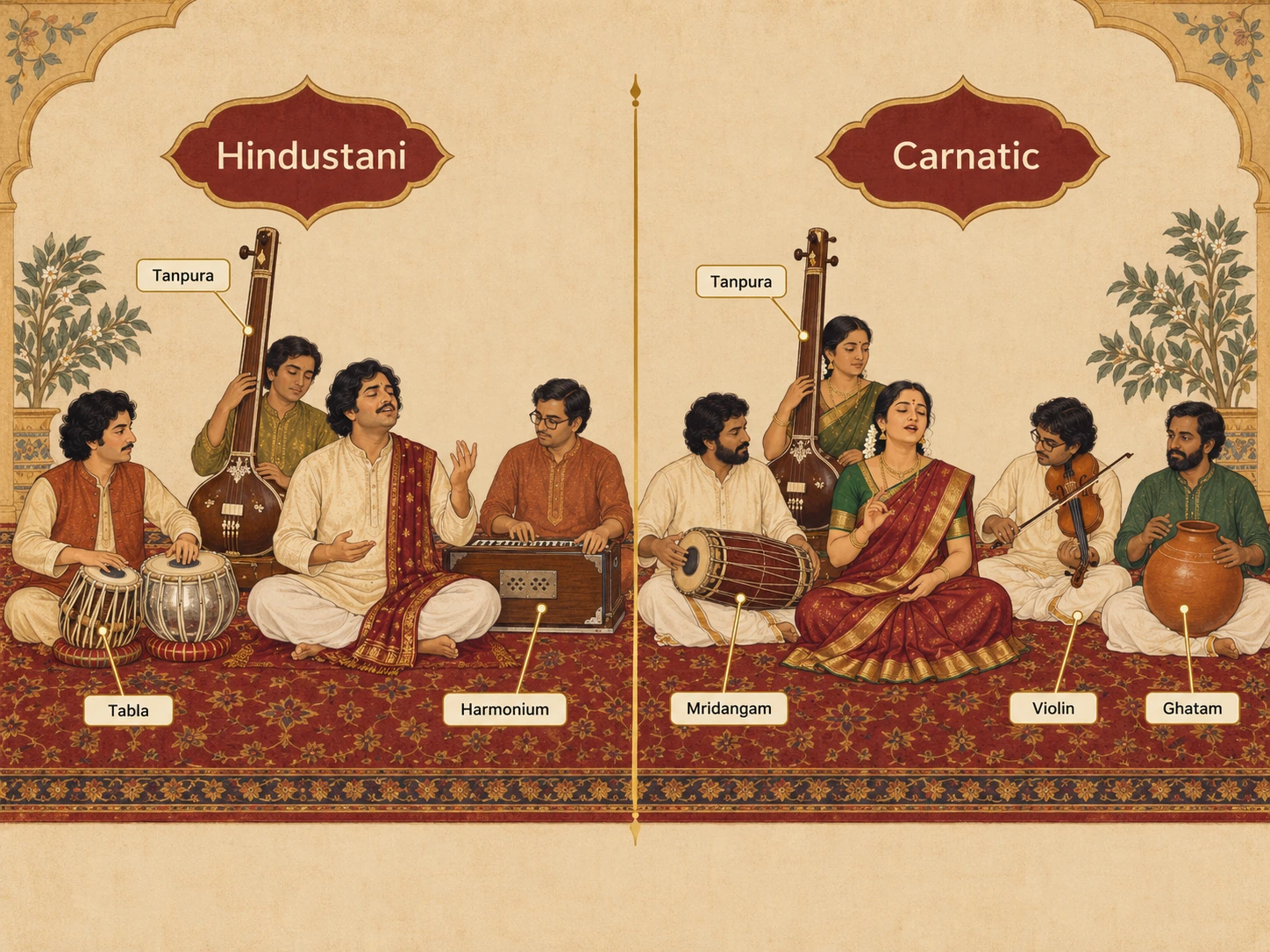
| Typical instruments | tanpura, harmonium, tabla, sitar, sarod, sarangi, bansuri | tanpura, veena, violin, mridangam, ghatam, flute |
A Hindustani performance usually gives a long, slow unfolding of one raga; a Carnatic concert is more often a sequence of composed pieces, each with improvisation woven in.
Same notes, different names
From level 3Both systems use Sa Re Ga Ma Pa Dha Ni (Carnatic: Sa Ri Ga Ma Pa Da Ni), but the word shuddha does not mean the same thing. In Hindustani music the shuddha swaras form Bilawal thaat, the major scale. In Carnatic music "shuddha" Ri, Ga, Da and Ni are the lowest positions of those notes, closer to Hindustani komal. Carnatic theory also gives some pitches two names (for example, one pitch can be called either a raised Ri or a lowered Ga), which is how it arrives at 72 melakartas instead of 32 possible thaats.
Where the ABGMVM stands
From level 3The Akhil Bharatiya Gandharva Mahavidyalaya Mandal examines in the Hindustani system. It grew out of the Gandharva Mahavidyalaya that Pt. Vishnu Digambar Paluskar founded at Lahore in 1901, and was formed by his disciples to carry on his mission of teaching classical music to the public through an organised syllabus and examinations.
Its syllabus uses Pt. Bhatkhande's ten-thaat system for ragas, and asks students to know both the Bhatkhande and Paluskar notation systems. The level 3 paper also asks for a brief introduction to the Mandal and biographies of Pt. Paluskar and Swami Haridas.
Exam questions
Answer these the way the examiner expects: short and exact.
Name the two main systems of Indian classical music. Level 3
Hindustani (North Indian) and Carnatic (South Indian).
How many parent scales does each system use? Level 3
Hindustani: 10 thaats (Pt. Bhatkhande). Carnatic: 72 melakartas (Venkatamakhi).
Name the Carnatic Trinity. Level 3
Tyagaraja, Muthuswami Dikshitar and Syama Shastri.
Which system does the ABGMVM follow? Level 3
The Hindustani system, using Pt. Bhatkhande's ten thaats and both the Bhatkhande and Paluskar notations.
Examined at
Related
Learning this with a teacher
These pages will take you a long way on theory. The singing needs a guru — live online classes, one level at a time, with exam preparation built in.