Naad
नाद
In short
A steady, pleasant sound produced by regular vibrations, the kind of sound music can use, is called naad.
संगीत में उपयोगी, नियमित आंदोलनों से उत्पन्न होने वाली स्थिर और मधुर ध्वनि को नाद कहते हैं।
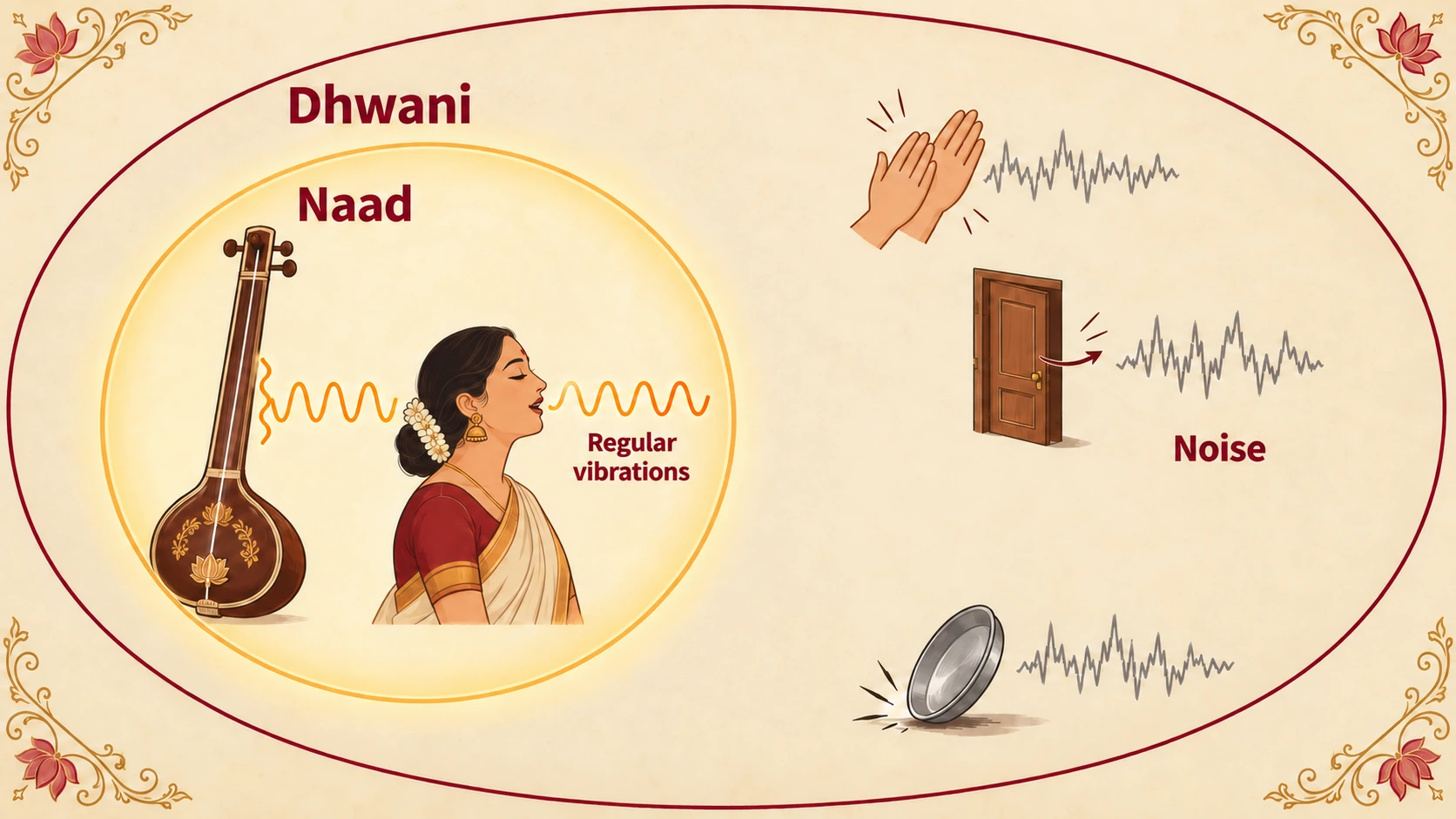
Sangeet, dhwani and naad
From level 2The level 2 definitions list begins with three words that build on each other.
- Sangeet (संगीत) is the combination of three arts: vocal music, instrumental music and dance. The classical line is गायनं वादनं नृत्यं त्रयं संगीत मुच्यते।
- Dhwani (ध्वनि) is any sound the ear can hear. It is produced when something vibrates (कंपन): a clap, a door, a voice.
- Naad (नाद) is the part of dhwani that music can use: a sound with regular, steady vibrations that is pleasant to hear. A tanpura string gives naad; a falling plate gives only noise.
So every naad is a dhwani, but not every dhwani is a naad.
Aahat and anahat naad
From level 2Tradition names two kinds of naad.
| Kind | Meaning | Example |
|---|---|---|
| Aahat naad (आहत) | "struck": produced by contact or friction, heard by the ear | voice, tanpura, tabla |
| Anahat naad (अनाहत) | "unstruck": the inner sound described by yogis, not produced by any contact | heard only in meditation, not used in performance |
All music we sing and play is aahat naad.
The three characteristics of naad
From level 3Every naad can be described by three qualities. This is a favourite level 3 question.
| Characteristic | Hindi | What you hear | Depends on |
|---|---|---|---|
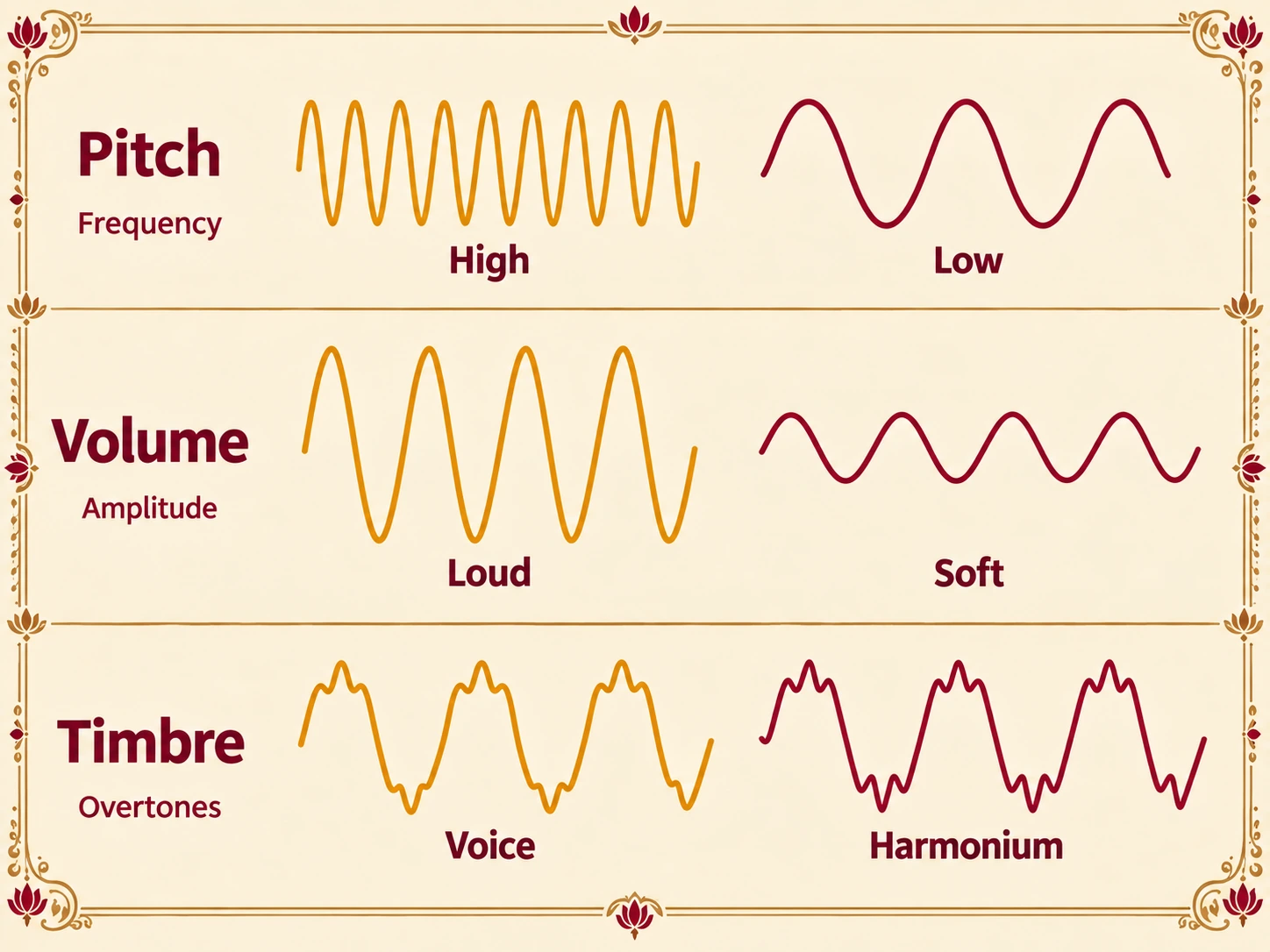
| Pitch | नाद का ऊँचा-नीचापन | how high or low the sound is | the number of vibrations per second (आंदोलन संख्या, frequency) |
| Volume | नाद का छोटा-बड़ापन | how loud or soft it is | the width of each vibration (आंदोलन की चौड़ाई, amplitude) |
| Timbre | नाद की जाति या गुण | the colour that tells a voice from a sitar on the same note | the faint higher sounds that ring along with the main note (सहायक नाद, overtones) |
A quick test: sing सा softly, then loudly. The pitch stays the same; only the volume changes. Now play the same सा on a harmonium. Pitch and volume can match your voice exactly, but you still hear the difference: that is timbre.
Shruti: the smallest steps of pitch
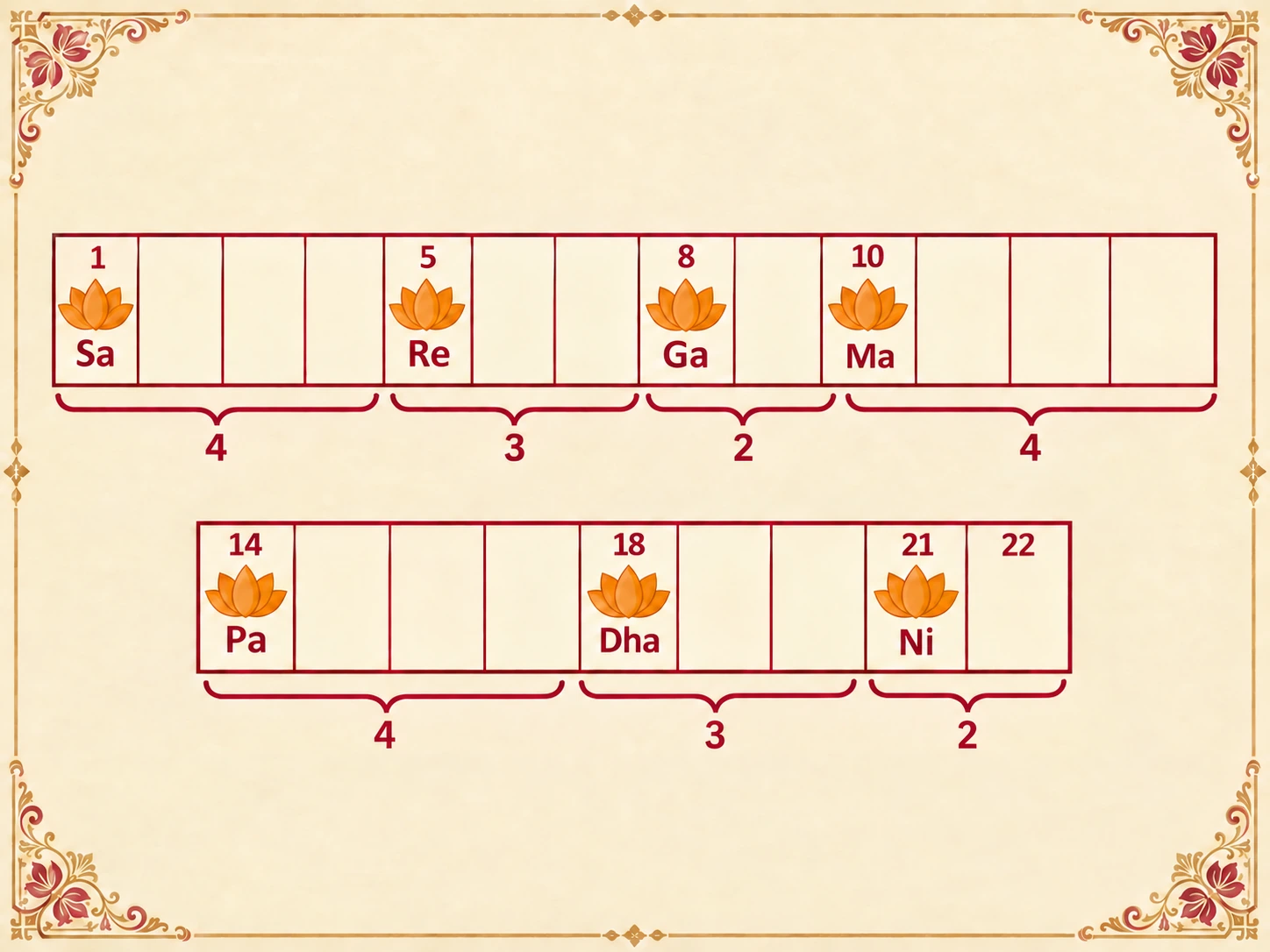
From level 3A shruti (श्रुति) is the smallest difference in pitch that a trained ear can clearly hear and tell apart. Indian theory counts 22 shrutis in one saptak, and the seven swaras are placed on some of them. The swaras are the shrutis music actually uses as notes.
The sequence is: dhwani (any sound) → naad (musical sound) → shruti (a distinguishable pitch) → swara (a shruti chosen as a note and made pleasant).
The physics behind naad and the 22 shrutis
From level 4At Madhyama the paper asks for the science.
- Vibration (कंपन) and oscillation (आंदोलन): a plucked string moves to one side, back through its resting point, to the other side and back. One such full movement is one aandolan. Regular aandolans give naad; irregular ones give noise.
- Pitch and string length: the shorter, tighter or thinner the string, the more aandolans per second and the higher the pitch. Pressing a sitar string at a fret shortens it and raises the note. Halving the length gives the same note one saptak higher.
- Volume and amplitude: pluck harder and the string swings wider; the note is louder but its pitch does not change.
The 22 shrutis among the seven swaras. The traditional distribution is Sa 4, Re 3, Ga 2, Ma 4, Pa 4, Dha 3, Ni 2. In the modern view (आधुनिक मत, followed by Pt. Bhatkhande) each shuddha swara sits on the first shruti of its group:
| Swara | सा | रे | ग | म | प | ध | नि |
|---|---|---|---|---|---|---|---|
| Shrutis in its group | 4 | 3 | 2 | 4 | 4 | 3 | 2 |
| Shruti it sits on (modern view) | 1 | 5 | 8 | 10 | 14 | 18 | 21 |
The ancient texts instead placed each swara on the last shruti of its group (सा on 4, रे on 7, and so on). Learn both, but answer with the modern view unless the question asks for the ancient one.
Exam questions
Answer these the way the examiner expects: short and exact.
What is the difference between dhwani and naad? Level 2
Dhwani is any sound the ear hears. Naad is a dhwani with regular, steady vibrations that is pleasant and usable in music.
Name the two kinds of naad. Level 2
Aahat naad (produced by striking or contact, used in music) and anahat naad (unstruck, inner sound).
What are the three characteristics of naad? Level 3
Pitch (ऊँचा-नीचापन), volume (छोटा-बड़ापन) and timbre (जाति or गुण).
What is a shruti? How many are there in a saptak? Level 3
The smallest interval of pitch the ear can clearly distinguish. There are 22 in a saptak.
What decides the pitch of a naad? Level 4
The number of vibrations per second (frequency). More vibrations give a higher pitch; a shorter string vibrates faster.
Related
Learning this with a teacher
These pages will take you a long way on theory. The singing needs a guru — live online classes, one level at a time, with exam preparation built in.