Dhrupad
ध्रुपद
In short
The oldest surviving form of Hindustani classical singing. It has four parts (sthayi, antara, sanchari, abhog), is preceded by nom-tom alaap, is sung to the pakhawaj in taals such as Chautaal, and is developed through layakari: dugun, tigun and chaugun.
हिंदुस्तानी शास्त्रीय संगीत का सबसे प्राचीन जीवित गीत प्रकार। इसके चार भाग होते हैं (स्थायी, अंतरा, संचारी, आभोग); इसे नोम-तोम आलाप के बाद चौताल जैसे तालों में पखावज के साथ गाया जाता है, और दुगुन, तिगुन, चौगुन से लयकारी की जाती है।
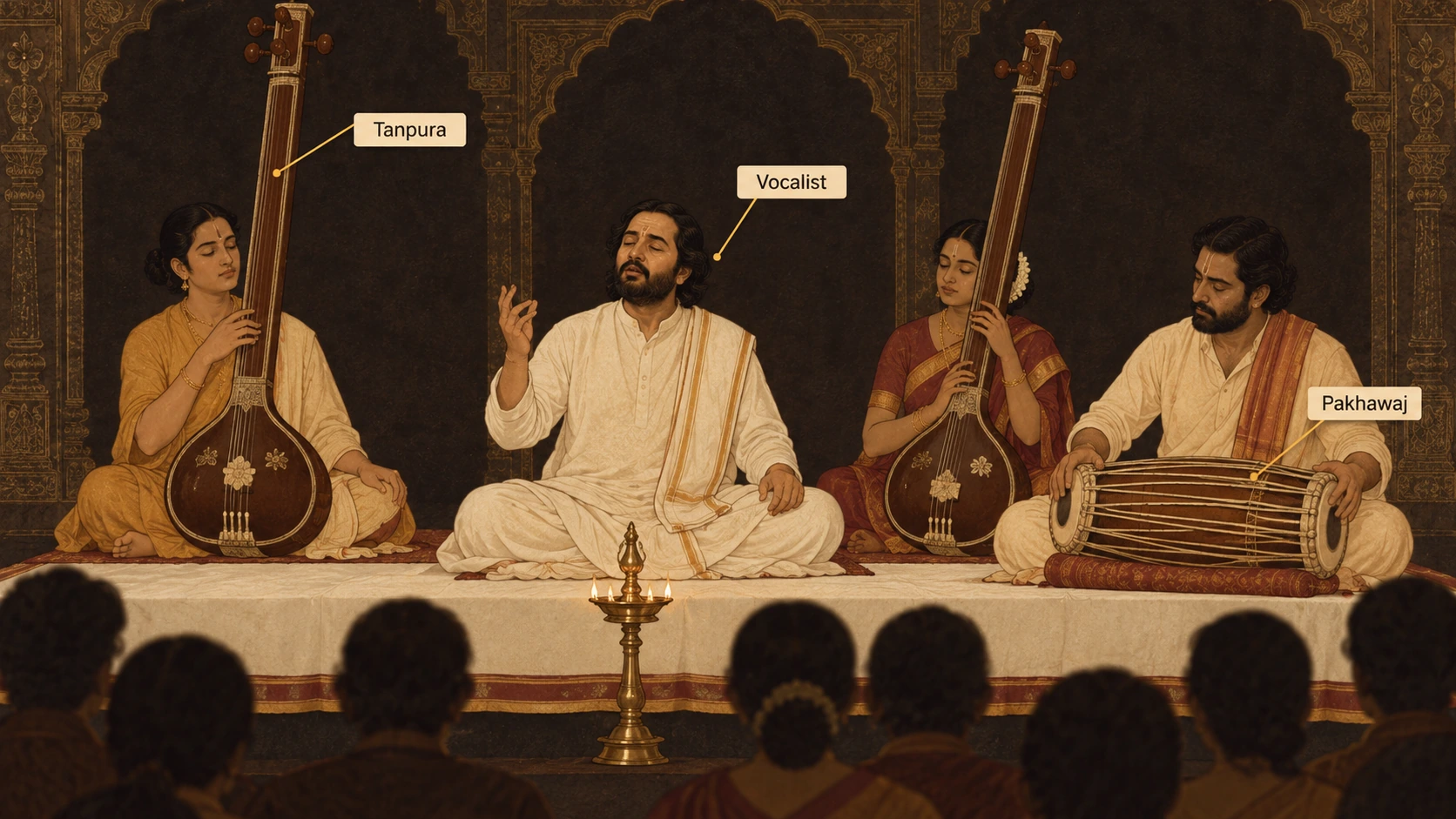
The oldest form still sung
From level 2Dhrupad (from dhruva pada, "fixed verse") is the oldest form of Hindustani classical music still performed. It grew out of the older prabandh songs and flourished at the court of Raja Man Singh Tomar of Gwalior around 1500. Swami Haridas, the saint-musician of Vrindavan, is traditionally named as the guru of Tansen, the most famous dhrupad singer, who sang at Akbar's court.
Dhrupad is grave and unhurried. Its texts, usually in Brajbhasha, praise deities, seasons or patrons. It is accompanied by the pakhawaj, a barrel drum played on both ends, not the tabla.
Dhrupad singers are grouped by four historical styles, the banis: Gauhar (Gobarhari), Khandar, Dagur and Nauhar. The Dagar family, the best-known dhrupad lineage today, takes its name from the Dagur bani.
How it is structured
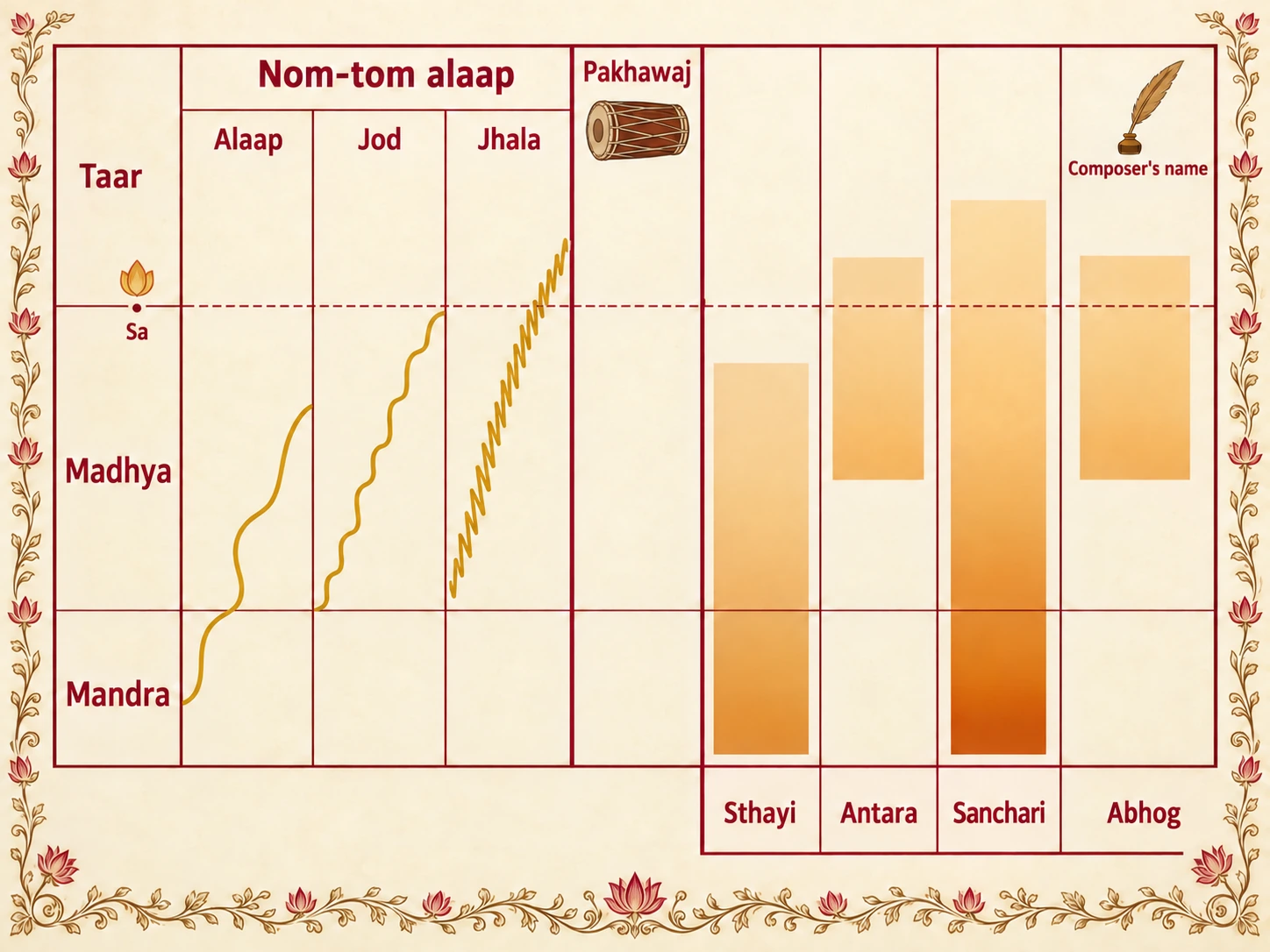
From level 3A full dhrupad has four parts. Some compositions have only the first two.
| Part | Character |
|---|---|
| Sthayi | stays in the mandra and madhya saptak; establishes the raga |
| Antara | rises to taar Sa and explores the upper notes |
| Sanchari | the most varied part; draws on all three saptaks, often lingering in the lower register |
| Abhog | the closing part; usually climbs like the antara and often carries the composer's name |
Before the composition comes the nom-tom alaap, sung not on aakar but on syllables such as a, na, ri, ta, num, tom. It unfolds in stages: slow and unmetred, then with a steady pulse (jod), then fast (jhala). Only then does the pakhawaj enter with the composition.
Dhrupad is usually set in Chautaal (12 matras); Sooltaal (10) and Teevra (7) are also common. Compositions in Dhamar taal form a separate genre, the dhamar.
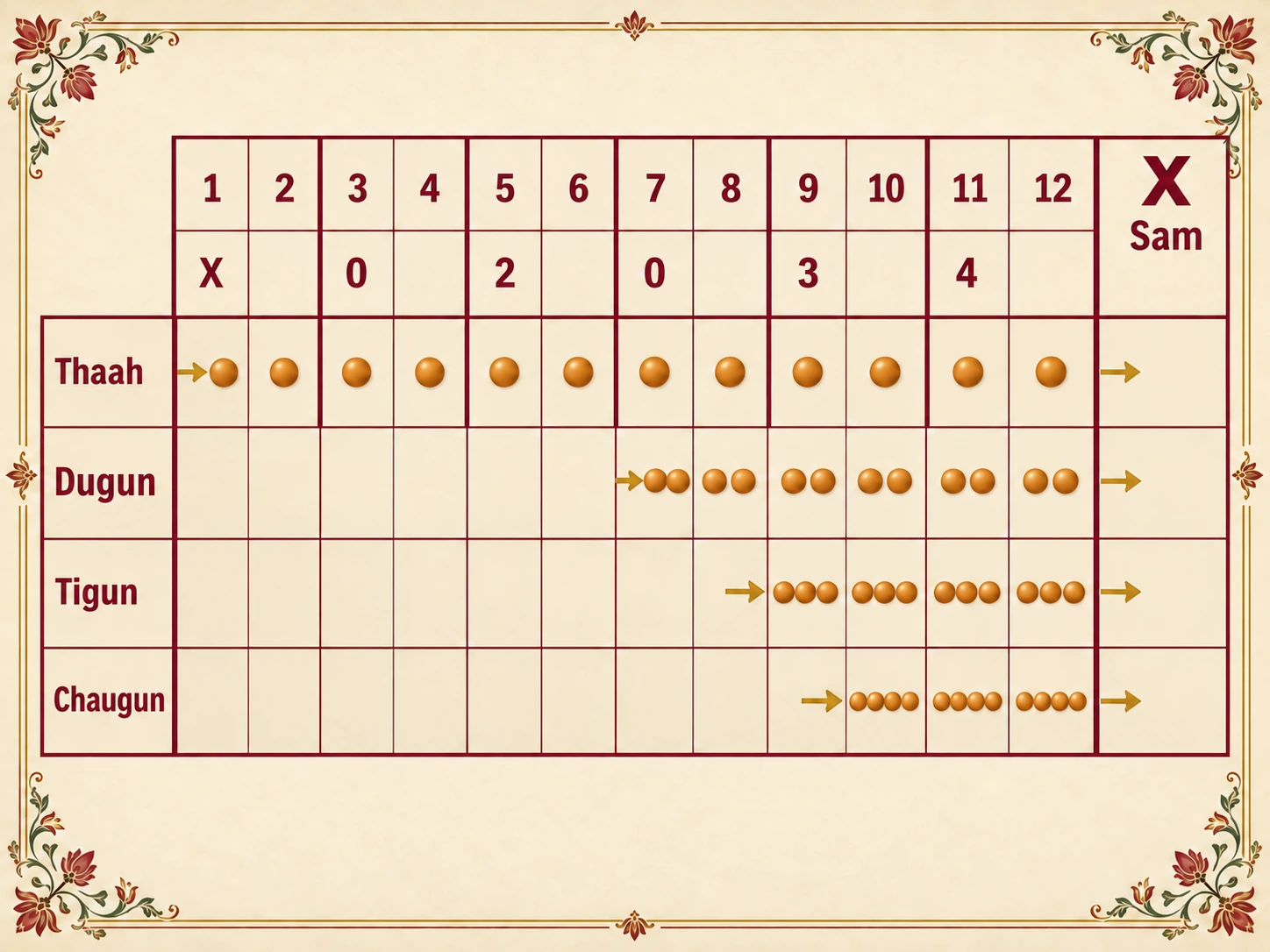
Layakari: dugun, tigun, chaugun
From level 2After singing the composition at its base speed (thaah), the singer sings the same words and swaras two, three or four times as fast while the pakhawaj keeps the original theka. The skill is to start at the right moment so the faster line still ends exactly on sam.
For a composition line one avartan of Chautaal (12 matras) long:
| Layakari | Bols per matra | The line takes | Start on |
|---|---|---|---|
| Thaah | 1 | 12 matras | matra 1 |
| Dugun | 2 | 6 matras | matra 7 |
| Tigun | 3 | 4 matras | matra 9 |
| Chaugun | 4 | 3 matras | matra 10 |
Chautaal theka: धा धा | दिं ता | किट धा | दिं ता | तिट कत | गदि गन, with taali on 1, 5, 9, 11 and khali on 3 and 7.
Advanced students also sing dedhgun (1½ times, also called aad) and bol-baant, a rhythmic play on the words over the theka.
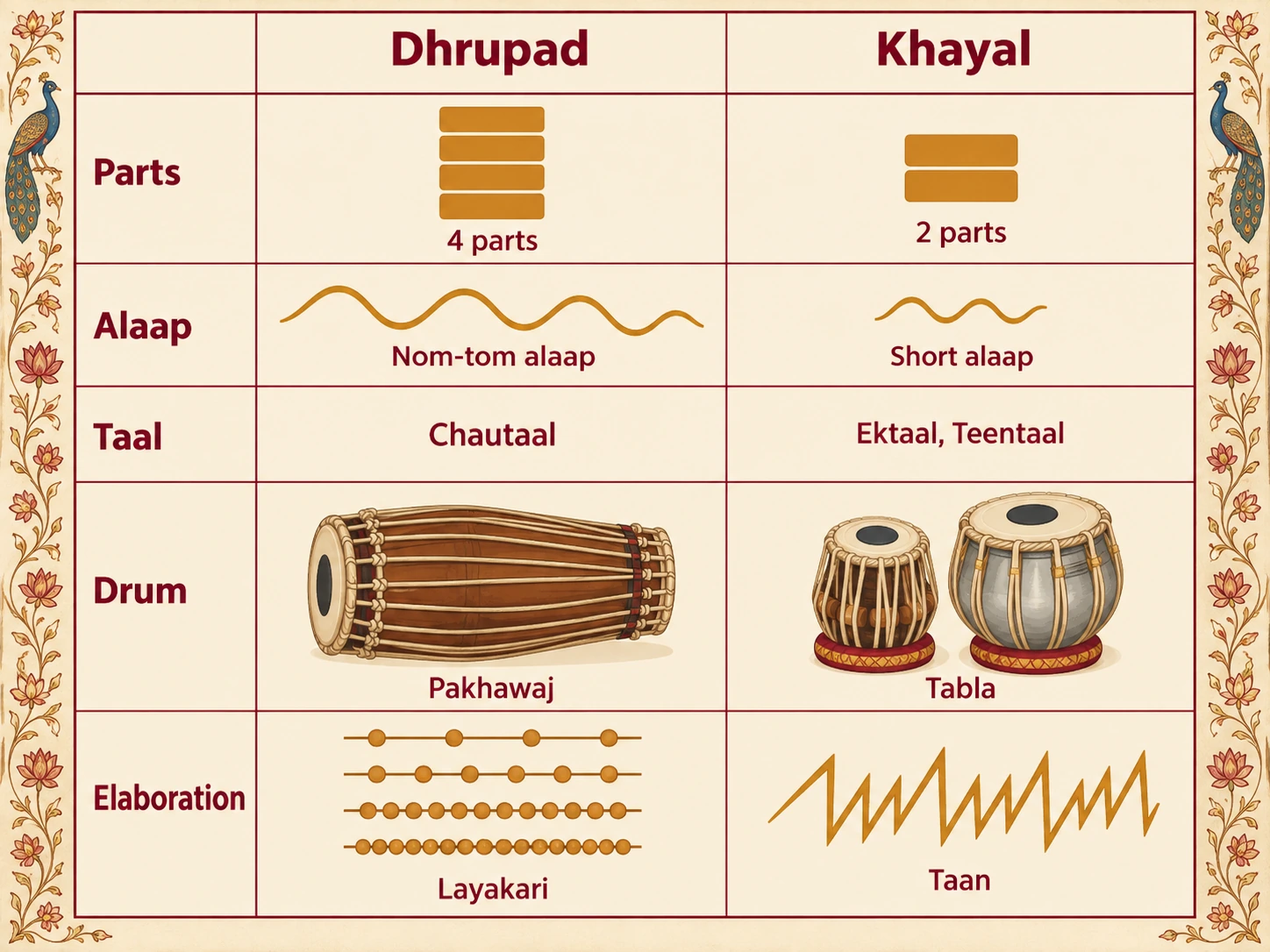
Dhrupad and khayal compared
From level 3| Dhrupad | Khayal | |
|---|---|---|
| Parts | four: sthayi, antara, sanchari, abhog | two: sthayi, antara |
| Alaap | long nom-tom alaap before the composition | short opening; most alaap woven in after the bandish |
| Typical taals | Chautaal, Sooltaal, Teevra | Ektaal, Jhumra, Tilwada, Teentaal, Jhaptaal |
| Drum | pakhawaj | tabla |
| Ornaments | meend, gamak; no taans or murkis | meend, gamak, murki, khatka, taans |
| Elaboration | layakari (dugun, tigun, chaugun) and bol-baant | bol-alaap, sargam, taan |
| Mood | grave, austere, devotional | wider range of moods, more flexible |
| Became prominent | 15th–16th century | 18th century |
How to practise it, and what the examiner listens for
From level 2Practise
- Clap Chautaal with taali and khali while reciting the theka until it is automatic.
- Sing the composition in thaah, slowly enough to pronounce every word fully.
- For dugun, say the words in rhythm first (two per clap), then sing them. Start on matra 7 and check that you land on sam.
- Add chaugun and tigun only when dugun is secure.
The examiner listens for
- the composition sung in thaah with clear words and a steady tempo;
- dugun (and later tigun, chaugun) that starts in the right place and lands on sam, while the base laya stays unchanged;
- a firm, open voice with gamak and meend, not khayal-style taans.
What each level asks: Praveshika Pratham, one dhrupad in thaah and dugun. Praveshika Dwitiya, the four parts in theory. Madhyama Pratham, thaah and chaugun, and writing dugun and chaugun. Madhyama Dwitiya, dugun, tigun and chaugun. Visharad and Alankar add dedhgun, bol-baant and nom-tom alaap.
Exam questions
Answer these the way the examiner expects: short and exact.
Which drum accompanies dhrupad? Level 2
The pakhawaj.
What is dugun? Level 2
Singing the composition at twice the speed of thaah: two bols in each matra.
Name the four parts of a dhrupad. Level 3
Sthayi, antara, sanchari and abhog.
In which taal is dhrupad usually sung? Level 3
Chautaal (12 matras). Sooltaal and Teevra are also used.
In Chautaal, on which matra does the dugun of a one-avartan line begin? Level 4
On matra 7, so that it ends on sam.
Name the four banis of dhrupad. Level 7
Gauhar (Gobarhari), Khandar, Dagur and Nauhar.
Learning this with a teacher
These pages will take you a long way on theory. The singing needs a guru — live online classes, one level at a time, with exam preparation built in.