Taal
ताल
In short
A taal is a fixed cycle of beats that repeats again and again through a piece of music.
ताल संगीत का वह समय-बद्ध चक्र है जिसमें मात्राएँ निश्चित क्रम से बार-बार आती हैं।
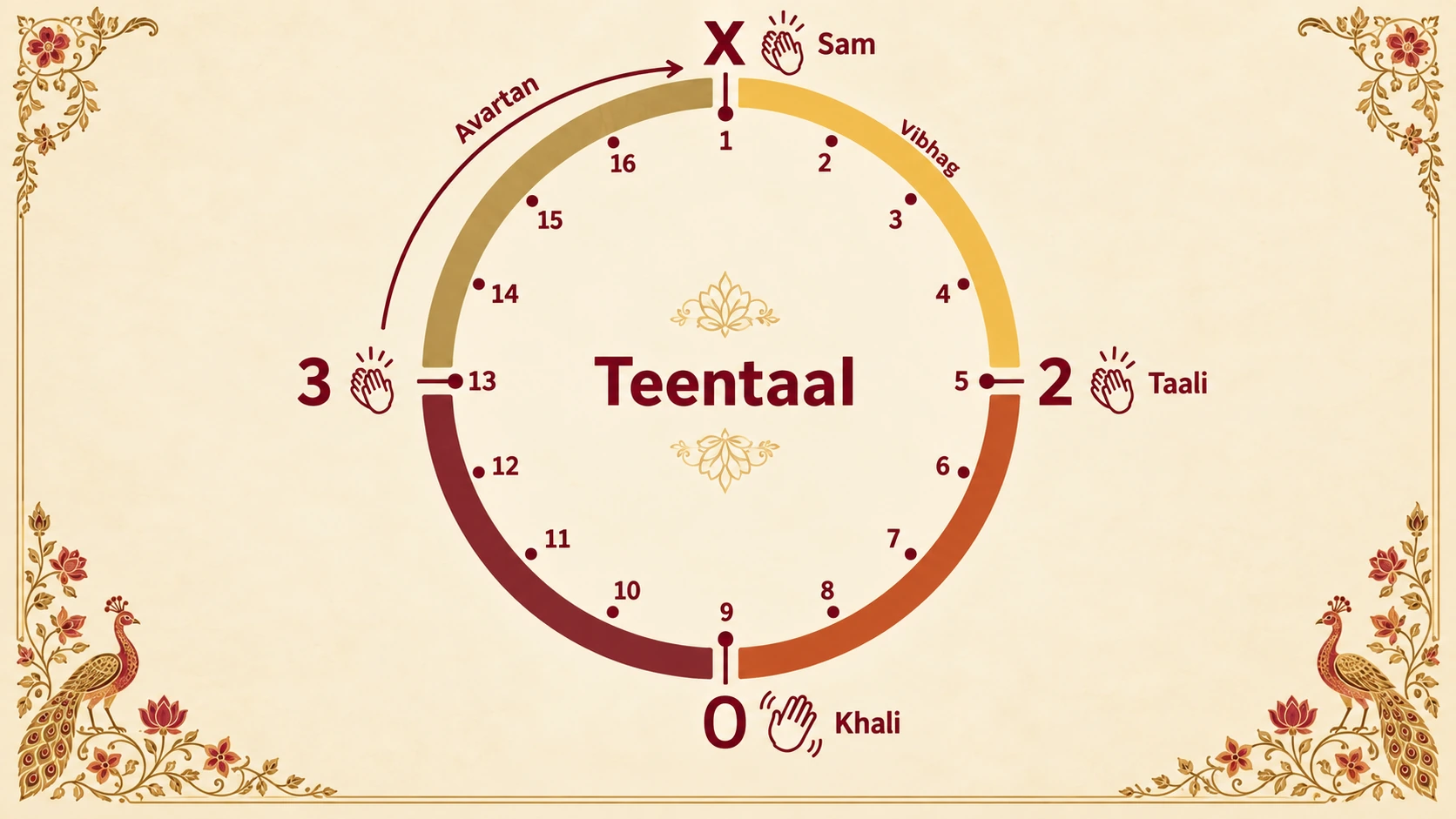
Matra, vibhag and avartan
From level 1A taal is a cycle of beats that keeps repeating under the music.
- Matra (मात्रा): one beat. Teentaal has 16, Keherwa 8, Dadra 6.
- Vibhag (विभाग, or khand): a section of the cycle. Teentaal divides 4 + 4 + 4 + 4; Keherwa 4 + 4; Dadra 3 + 3.
- Avartan (आवर्तन): one complete round, from sam back to sam.
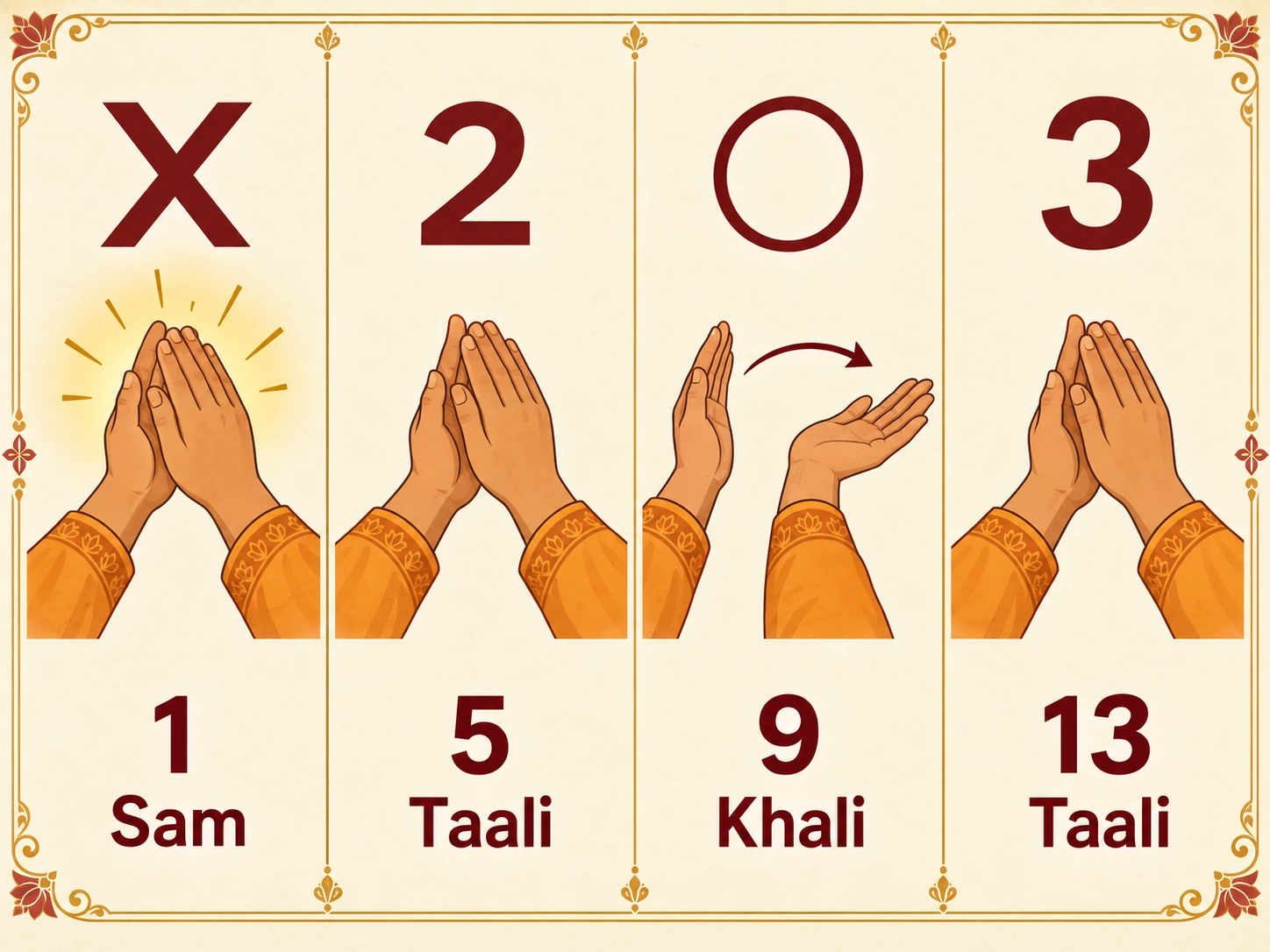
Sam, taali, khali: reading X 2 0 3
From level 1Each vibhag begins with either a clap or a wave.
- Sam (सम): matra 1, the strongest beat, where the cycle begins and every phrase aims to land. Marked X.
- Taali (ताली): a vibhag that begins with a clap. Marked by its number in the order of claps: 2, 3, 4.
- Khali (खाली, "empty"): a vibhag that begins with a wave of the hand instead of a clap. Marked 0.
Teentaal, therefore, is written:
| Matra | 1 | 5 | 9 | 13 |
|---|---|---|---|---|
| Sign | X | 2 | 0 | 3 |
| Hand | clap | clap | wave | clap |
So "X 2 0 3" reads: sam with a clap, second clap, khali with a wave, third clap. Sam counts as the first clap, which is why the next clap is numbered 2.
Keherwa is X 0 (clap on 1, wave on 5) and Dadra is X 0 (clap on 1, wave on 4). One exception to remember: in Roopak, sam falls on a khali.
Theka
From level 1A theka (ठेका) is the basic pattern of tabla bols that identifies a taal.
| Taal | Matras | Theka |
|---|---|---|
| Teentaal | 16 | धा धिं धिं धा, धा धिं धिं धा, धा तिं तिं ता, ता धिं धिं धा |
| Keherwa | 8 | धा गे ना ती, न क धी ना |
| Dadra | 6 | धा धिं ना, धा तिं ना |
In the exam you must recite the theka while keeping the taal with your hand: claps and waves in the right places, bols in steady laya. Practise with a slow, even count before you speed up. Notice that in Teentaal the khali vibhag uses the "open" bols तिं and ता: the khali is heard as well as seen.
Writing a taal in notation
From level 3The level 3 paper asks you to write the taals you have learned with matra, sam, khali, taali, vibhag and theka. In Bhatkhande notation, Teentaal is written in three rows:
| 1 | 2 | 3 | 4 | 5 | 6 | 7 | 8 | 9 | 10 | 11 | 12 | 13 | 14 | 15 | 16 |
|---|---|---|---|---|---|---|---|---|---|---|---|---|---|---|---|
| धा | धिं | धिं | धा | धा | धिं | धिं | धा | धा | तिं | तिं | ता | ता | धिं | धिं | धा |
| X | 2 | 0 | 3 |
- Matra numbers on top.
- Bols in the middle, one per matra.
- Signs below the first matra of each vibhag.
- In your notebook, draw a vertical line ( | ) after each vibhag: after matras 4, 8 and 12.
The same taal in the Paluskar system is covered under Swarlipi.
Exam questions
Answer these the way the examiner expects: short and exact.
What is a taal? Level 1
A fixed cycle of matras that repeats throughout a piece of music.
Give the matras, vibhags, taali and khali of Teentaal. Level 1
16 matras; 4 vibhags of 4 each; taali on 1 (sam), 5 and 13; khali on 9.
What is sam? How is it marked? Level 2
The first matra of the taal, where the cycle begins. Marked X.
What is khali? How is it marked? Level 2
A vibhag shown with a wave of the hand instead of a clap. Marked 0.
What is a theka? Level 2
The basic bols of a taal, played on the tabla, that identify it.
What is an avartan? Level 2
One complete cycle of the taal, from sam back to sam.
Learning this with a teacher
These pages will take you a long way on theory. The singing needs a guru — live online classes, one level at a time, with exam preparation built in.