Laya
लय
In short
Laya is tempo: how fast or slow the music is being performed.
लय का अर्थ है गति: संगीत कितनी तेज़ या धीमी चाल में प्रस्तुत किया जा रहा है।
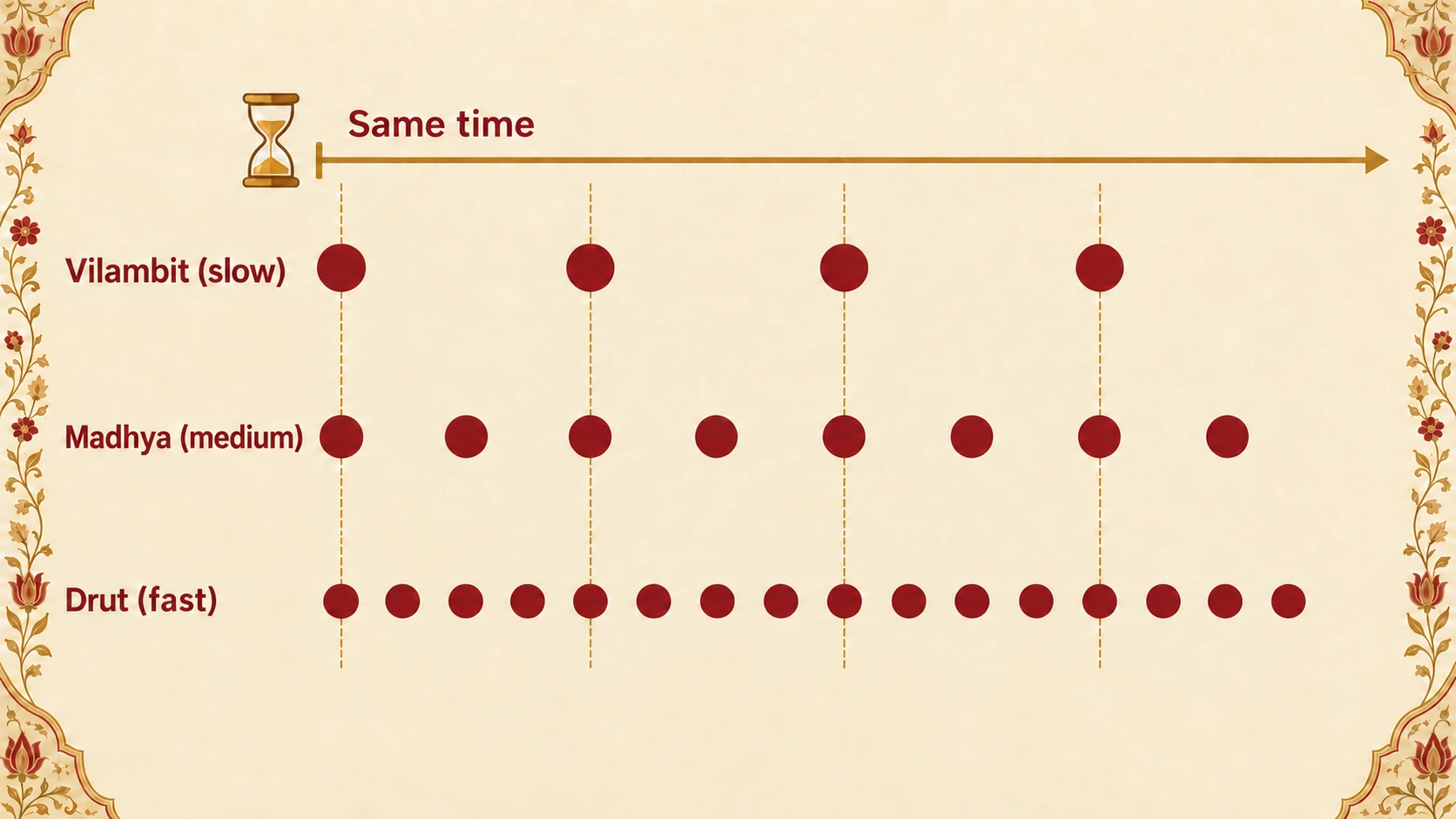
Three speeds
From level 2Laya is the speed at which the beats of a taal follow each other. The taal is the cycle; the laya is how fast you move through it. Once a laya is set, it must stay steady: rushing or dragging is the most common laya fault.
| Laya | Speed | Where you meet it |
|---|---|---|
| Vilambit (विलंबित) | slow | bada khayal, e.g. in vilambit Ektaal |
| Madhya (मध्य) | medium, a relaxed walking pace | most bandishes at levels 1 to 3 |
| Drut (द्रुत) | fast | chhota khayal in drut, tarana |
These are relative. Madhya is roughly double vilambit; drut is roughly double madhya.
Thaah, dugun, tigun and chaugun
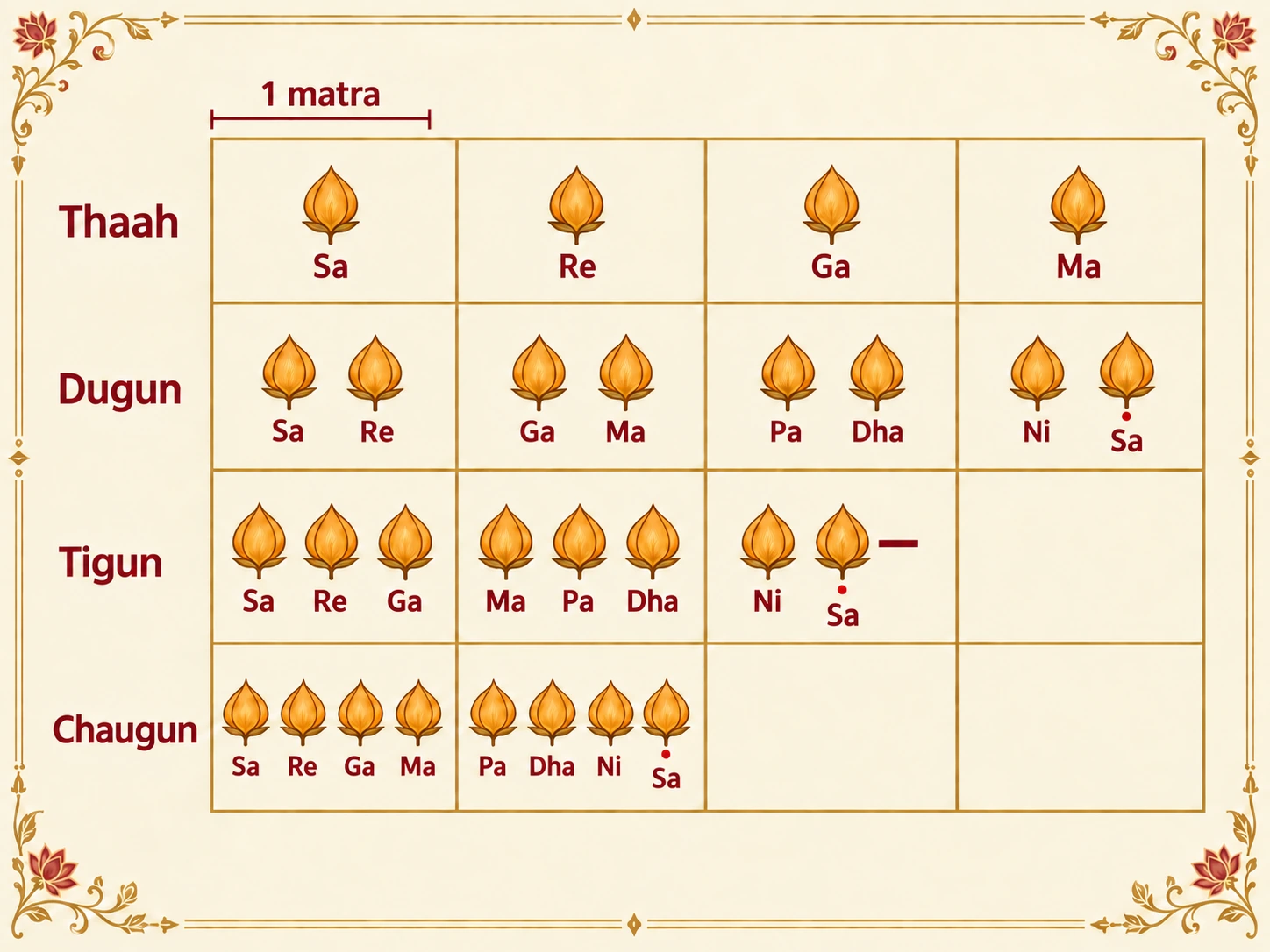
From level 2Laykari (लयकारी) means changing how many notes or bols you fit into each matra while the taal itself keeps the same speed.
| Name | Per matra | सा रे ग म प ध नि सां over the beats |
|---|---|---|
| Thaah (ठाह) | 1 | सा / रे / ग / म / प / ध / नि / सां |
| Dugun (दुगुन) | 2 | सारे / गम / पध / निसां |
| Tigun (तिगुन) | 3 | सारेग / मपध / निसांऽ |
| Chaugun (चौगुन) | 4 | सारेगम / पधनिसां |
Thaah is "barabar ki laya", one to one. Dugun is twice as many in the same time, and so on. (In tigun the eight notes do not divide evenly by three, so the last slot is a held ऽ.)
Worked example: dugun of Teentaal
From level 3Teentaal's theka in thaah, first vibhag:
| Matra | 1 | 2 | 3 | 4 |
|---|---|---|---|---|
| Thaah | धा | धिं | धिं | धा |
| Sign | X |
In dugun each matra holds two bols, so the same four matras hold the first eight bols of the theka:
| Matra | 1 | 2 | 3 | 4 |
|---|---|---|---|---|
| Dugun | धाधिं | धिंधा | धाधिं | धिंधा |
| Sign | X |
In Bhatkhande notation, the two bols that share a matra are written together with a small arc (‿) beneath them. The whole 16-bol theka in dugun therefore takes only 8 matras: one avartan of the taal holds the theka twice.
Practise it: clap the taal steadily in thaah with your hand, and recite the bols in dugun with your voice. Your hand must not speed up.
Starting so you land on sam
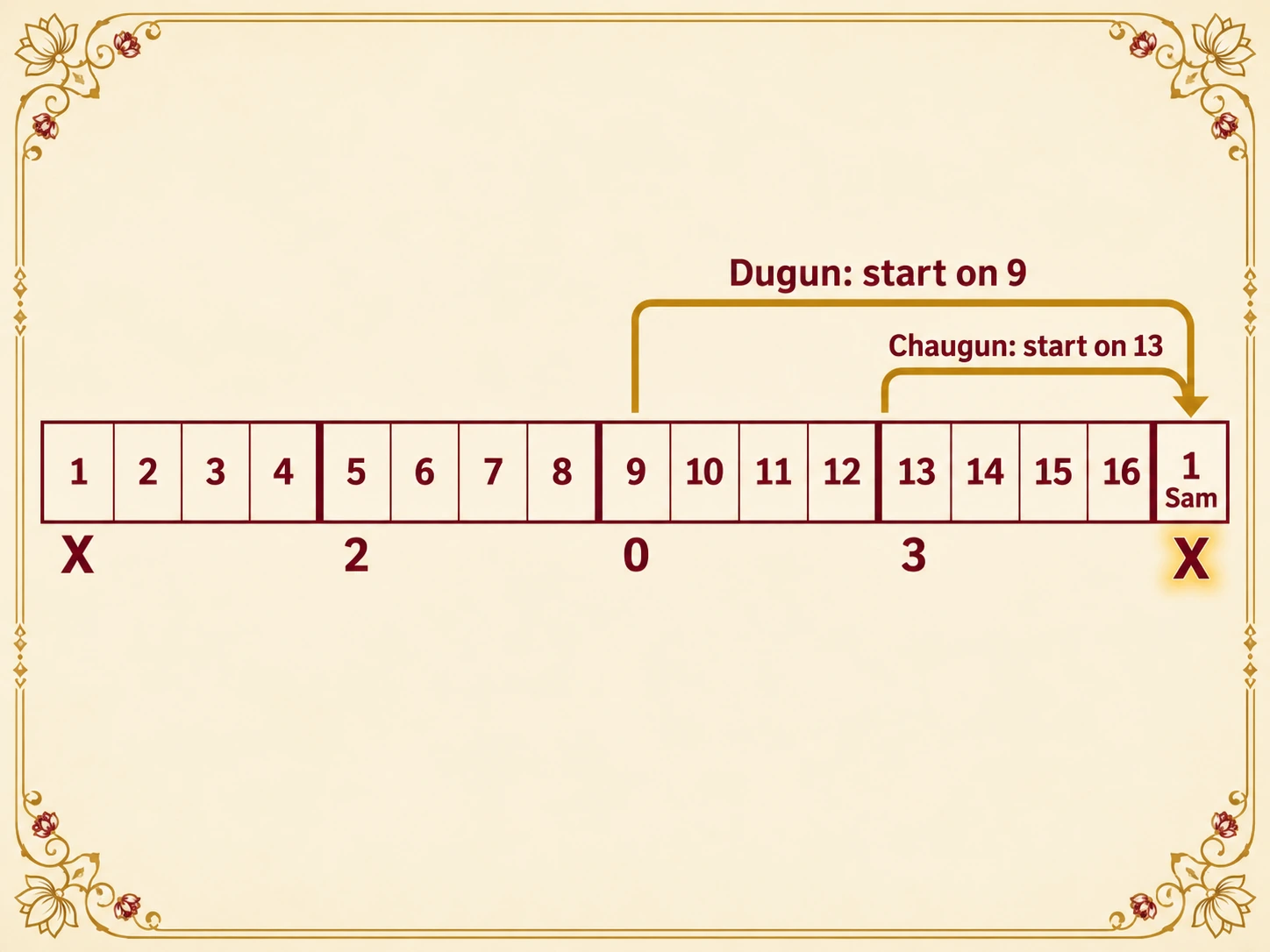
From level 3If you begin a single dugun of the theka on sam, it finishes at matra 8, leaving eight empty matras before the next sam. To make a single dugun of the theka end on sam, start it halfway through the avartan:
| Matra | 9 | 10 | 11 | 12 | 13 | 14 | 15 | 16 | 1 |
|---|---|---|---|---|---|---|---|---|---|
| Bols | धाधिं | धिंधा | धाधिं | धिंधा | धातिं | तिंता | ताधिं | धिंधा | धा |
| Sign | 0 | 3 | X |
The rule: a theka of N matras in a laykari of k bols per matra lasts N ÷ k matras, so start that many matras before sam. For Teentaal: dugun from matra 9, chaugun from matra 13.
Tigun (level 4): 16 ÷ 3 = 5⅓ matras, so it starts on the last third of matra 11. Matra 11 is written ऽऽधा (two silent thirds, then the first bol), and the tigun runs from there to the end of matra 16, landing on sam. The level 4 syllabus asks for dugun, tigun and chaugun of earlier taals in this way.
Exam questions
Answer these the way the examiner expects: short and exact.
What is laya? Level 2
The speed or tempo at which music is performed.
Name the three main layas. Level 2
Vilambit (slow), madhya (medium) and drut (fast).
What is dugun? Level 2
Fitting two notes or bols into each matra, so the music moves twice as fast against the same taal.
Write the first vibhag of Teentaal's theka in dugun. Level 3
धाधिं धिंधा धाधिं धिंधा (two bols per matra over matras 1 to 4).
From which matra should a dugun of Teentaal start so that it ends on sam? Level 3
Matra 9.
Learning this with a teacher
These pages will take you a long way on theory. The singing needs a guru — live online classes, one level at a time, with exam preparation built in.