Dhamar
धमार
In short
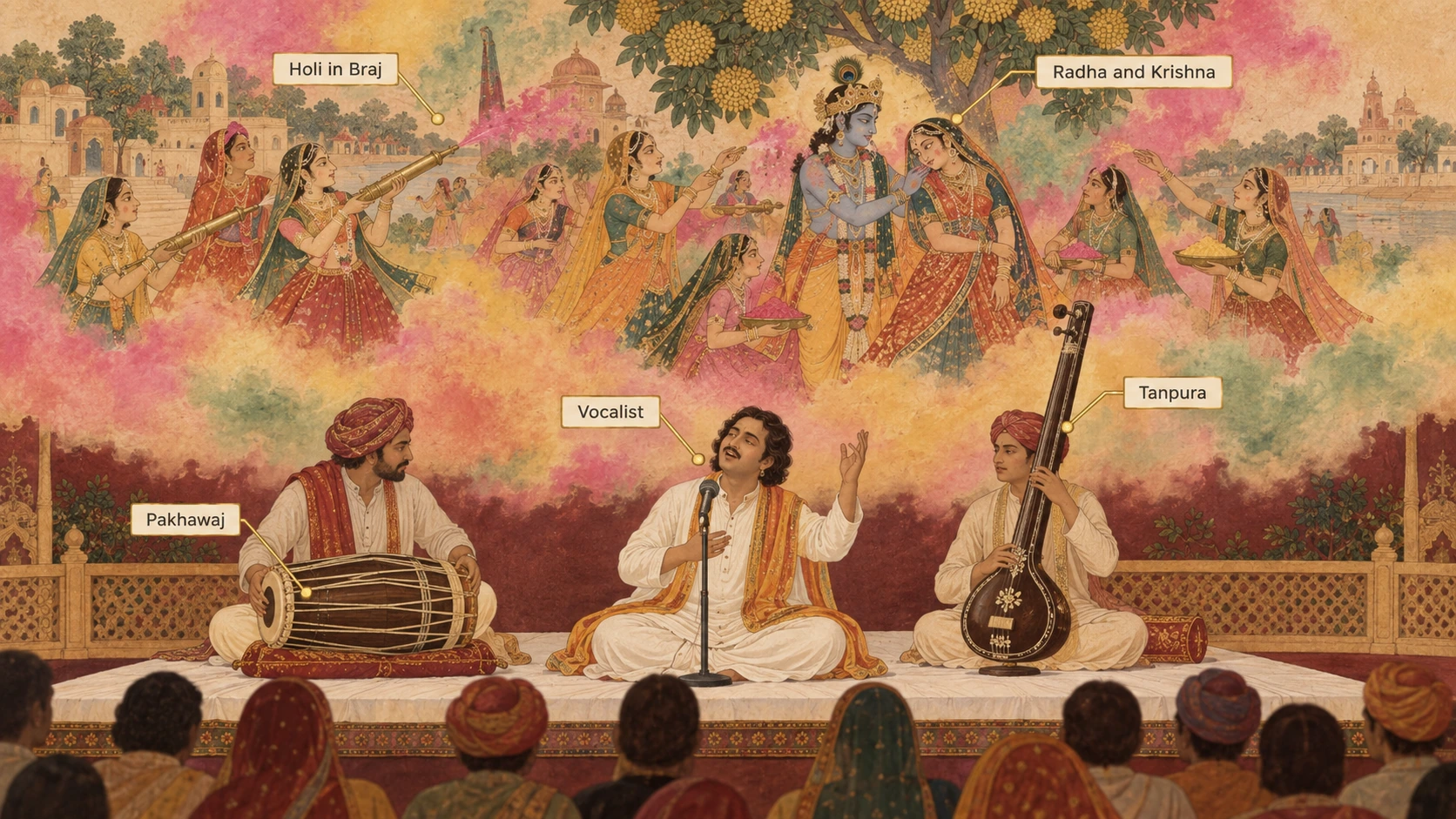
A dhrupad-style song sung in Dhamar taal (14 matras), its words usually about Holi in Braj and Radha and Krishna. It is accompanied by the pakhawaj, and layakari (dugun, tigun, chaugun) is its main feature.
धमार ताल (14 मात्रा) में गाया जाने वाला ध्रुपद शैली का गीत, जिसके बोल प्रायः ब्रज की होली और राधा-कृष्ण के बारे में होते हैं। इसे पखावज के साथ गाया जाता है और दुगुन, तिगुन, चौगुन की लयकारी इसका मुख्य अंग है।
Dhrupad's festive sibling
From level 3Dhamar is a composition sung in Dhamar taal. It belongs to the dhrupad family: it is sung by dhrupad singers, preceded by nom-tom alaap, accompanied by the pakhawaj, and developed through layakari rather than taans.
What sets it apart is the mood. Most dhamars describe Holi in Braj: Krishna and the gopis throwing colour, the spring season, the play of Radha and Krishna. The language is Brajbhasha, and the music is lighter and more playful than the austere dhrupad.
Do not confuse it with two neighbours:
- Dhamar taal, the 14-matra taal itself (a dhamar is a song in that taal);
- the hori of semi-classical music, a Holi song sung in thumri style, often in Deepchandi taal.
How it is structured
From level 3Most dhamars have a sthayi and an antara; some have all four dhrupad parts. A performance runs: nom-tom alaap, the composition in thaah, then layakari and bol-baant over the pakhawaj, returning to the mukhda each time.
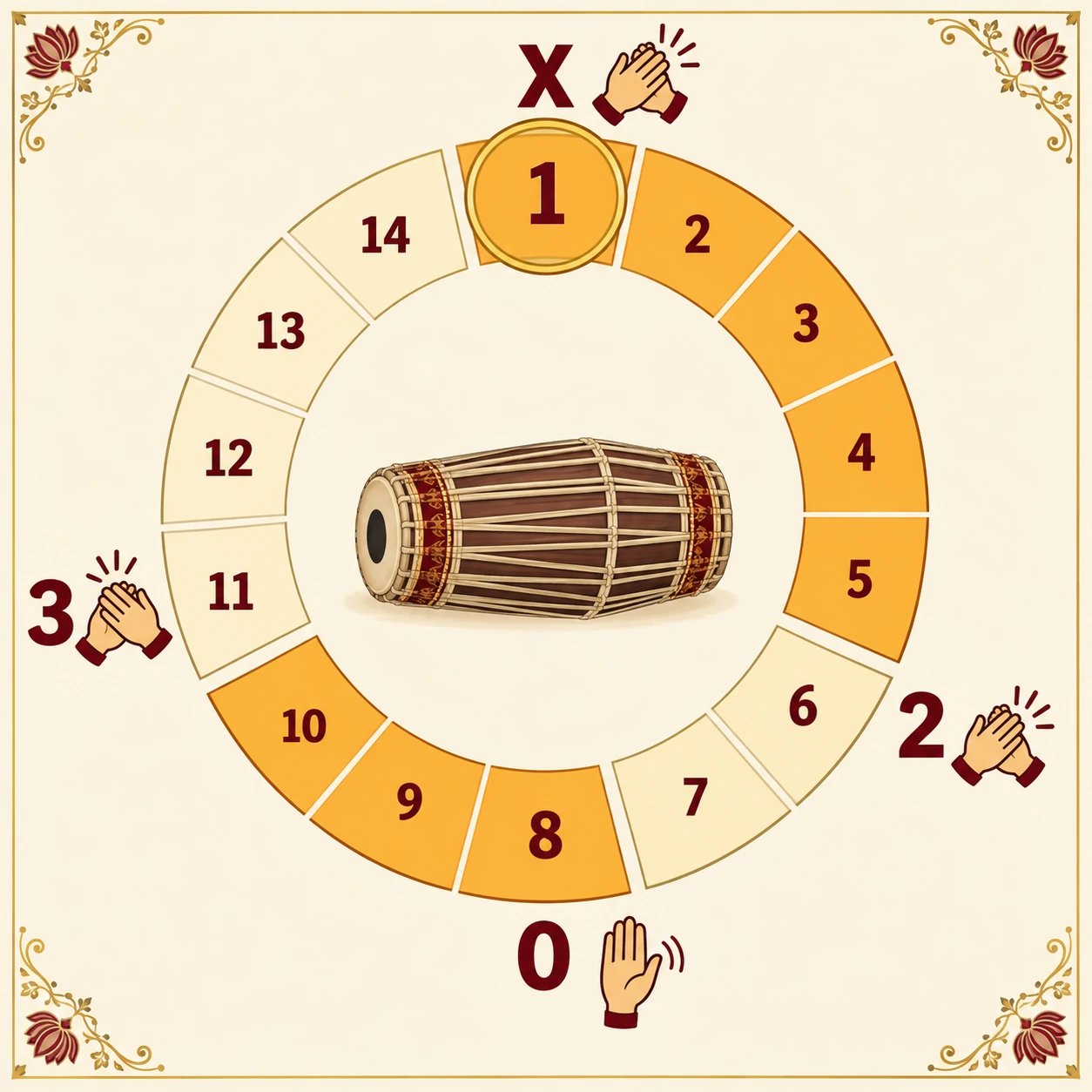
Dhamar taal
| Matras | Vibhags | Taali | Khali |
|---|---|---|---|
| 14 | 4 (5 + 2 + 3 + 4) | 1 (sam), 6, 11 | 8 |
Theka: क धि ट धि ट | धा ऽ | ग ति ट | ति ट ता ऽ
The uneven vibhags give dhamar its swinging, lilting feel. Learn to feel the long first vibhag of five matras.
Layakari in fourteen matras
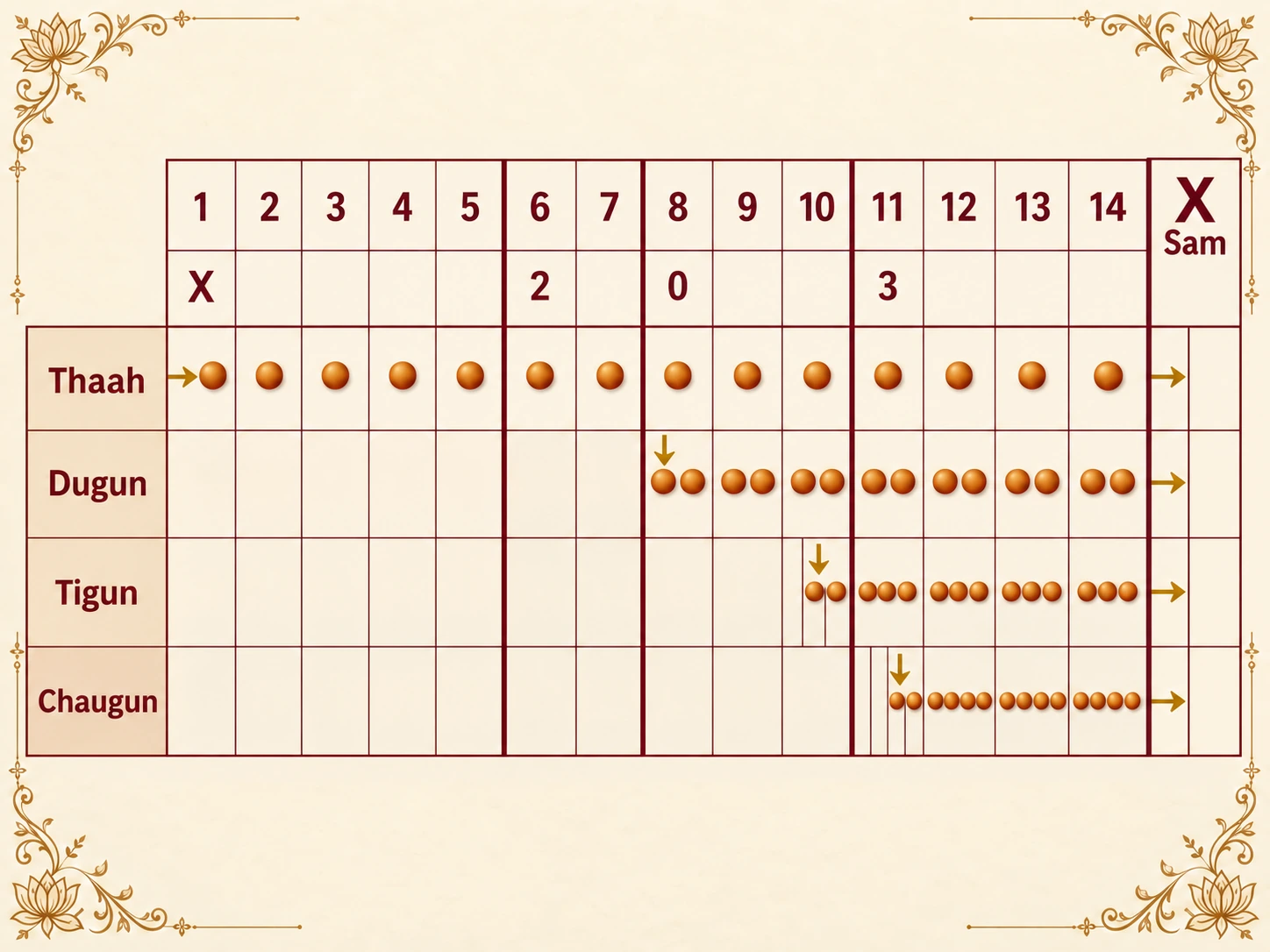
From level 3The ABGMVM asks for dhamar in thaah and dugun at Praveshika Dwitiya, adds chaugun at Madhyama Pratham and tigun at Madhyama Dwitiya. For a line one avartan (14 matras) long, start here so that you land on sam:
| Layakari | Bols per matra | The line takes | Start |
|---|---|---|---|
| Thaah | 1 | 14 matras | on matra 1 |
| Dugun | 2 | 7 matras | on matra 8 (the khali) |
| Tigun | 3 | 4⅔ matras | one third of the way into matra 10 |
| Chaugun | 4 | 3½ matras | halfway through matra 11 |
Some teachers instead start the dugun on sam and sing the line twice within one avartan. Both reach sam correctly; follow the method your teacher uses.
How to practise it, and what the examiner listens for
From level 3Practise
- Clap Dhamar taal, saying the theka aloud, until the 5 + 2 + 3 + 4 grouping feels natural.
- Sing the dhamar in thaah with the theka on a pakhawaj or tabla recording.
- Recite the words in dugun with claps before singing them. Mark matra 8 in your notebook as your starting point.
- Write out the dugun and chaugun in notation; the syllabus asks for it in writing from Madhyama Pratham.
The examiner listens for
- an unwavering base laya while you change speed;
- every layakari landing exactly on sam;
- words that stay whole and audible at double and quadruple speed;
- the raga kept pure, with dhrupad-style gamak and meend rather than khayal taans.
Exam questions
Answer these the way the examiner expects: short and exact.
How many matras and vibhags does Dhamar taal have? Level 3
14 matras in 4 vibhags of 5, 2, 3 and 4.
What is the usual subject of a dhamar? Level 3
Holi in Braj: Krishna, Radha and the gopis playing with colour.
Which drum accompanies a dhamar? Level 3
The pakhawaj.
On which matra does the dugun of a one-avartan dhamar line begin? Level 3
On matra 8, so that it ends on sam.
How is a dhamar different from a hori? Level 6
A dhamar is a dhrupad-style composition in Dhamar taal with pakhawaj; a hori is a semi-classical Holi song in thumri style, often in Deepchandi.
Learning this with a teacher
These pages will take you a long way on theory. The singing needs a guru — live online classes, one level at a time, with exam preparation built in.