Swarlipi (Notation)
स्वरलिपि
In short
Swarlipi is the method of writing music down, with signs for its swaras and its taal.
संगीत को स्वर और ताल के चिह्नों सहित लिखने की विधि को स्वरलिपि कहते हैं।
Why notation matters
From level 2For centuries Hindustani music was passed on only from guru to student, by ear. Two great teachers of the early twentieth century made systems to write it down: Pt. Vishnu Narayan Bhatkhande and Pt. Vishnu Digambar Paluskar, the founder of the Gandharva Mahavidyalaya.
Notation cannot capture everything (the exact shape of a meend or a kan still has to be learned by listening), but it lets you preserve a bandish, revise it, and write it in the exam. Bhatkhande notation is the one most used across North India today, and the one used throughout this site.
Bhatkhande notation
From level 2Swaras
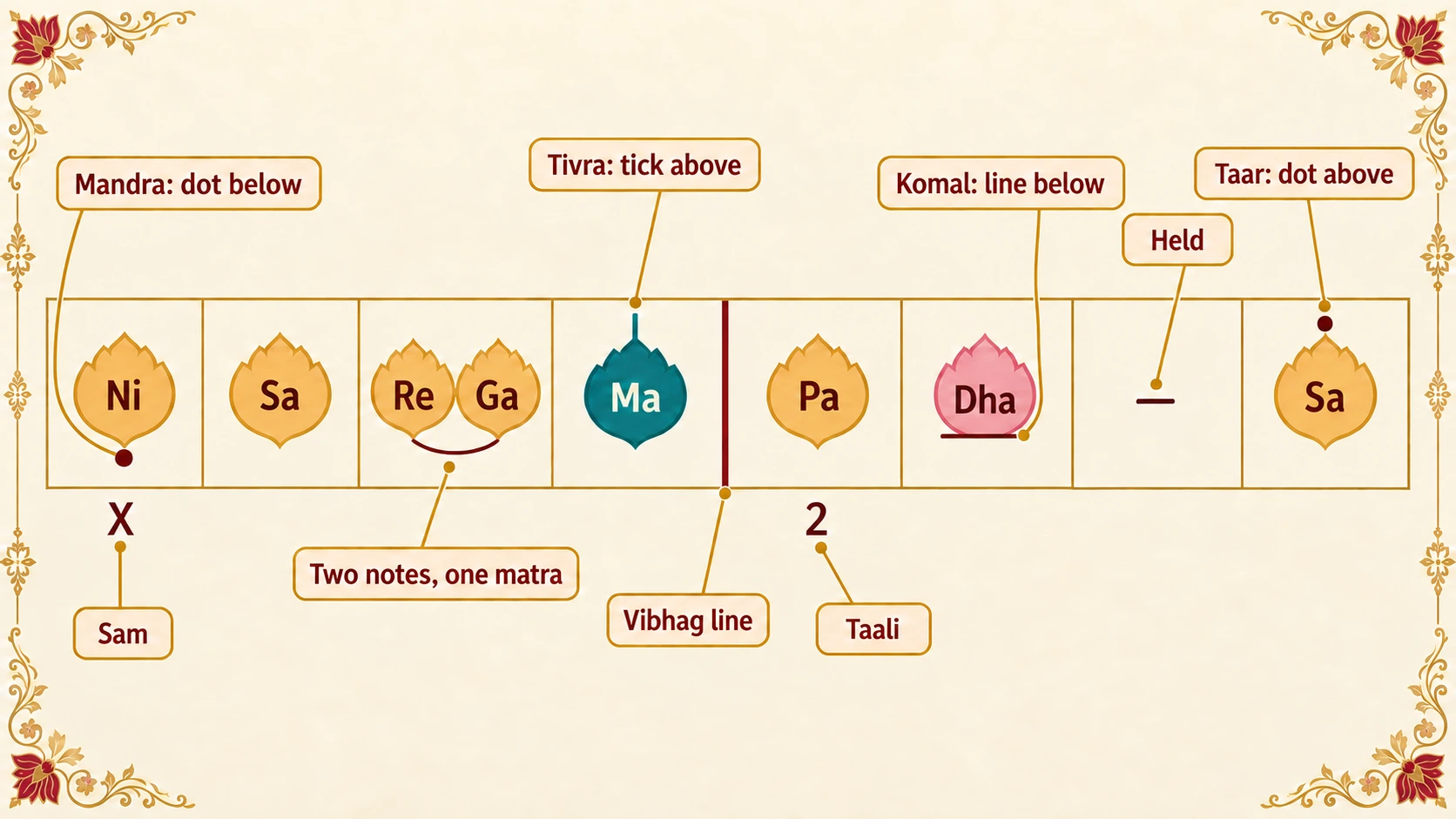
- Shuddha: no mark (सा रे ग).
- Komal: a line below (रे॒ ग॒ ध॒ नि॒).
- Tivra: a vertical line above (म॑).
- Mandra saptak: a dot below (ध़ नि़).
- Taar saptak: a dot above (सां रें).
Time
- One note per matra: no mark.
- Two or more notes in one matra: written together with an arc (‿) beneath them, e.g. सारे.
- A note held for extra matras: a dash in each extra matra, e.g. सा − −.
- A sung syllable held: avagraha ऽ.
Taal: sam X, khali 0, taalis numbered 2, 3, 4 in order of claps, a vertical line after each vibhag.
Ornaments: meend as an arc over the notes; kan as a small note above-left of the main note; khatka as a note in brackets, (सा).
Paluskar notation
From level 3Pt. Paluskar's system uses several of the same marks for different things, which is exactly what examiners test.
Swaras
- Komal: a halant (्) below the note, e.g. ग्.
- Tivra म: an inverted halant below it.
- Mandra saptak: a dot above the note.
- Taar saptak: a small vertical line above the note.
Time: each duration has its own sign under the note. A line beneath is one matra (laghu); a small circle is half a matra (drut); a small arc is a quarter (anudrut); ऽ marks two matras.
Taal: sam is written 1, khali +, and each taali by the number of the matra it falls on. Vibhags are not separated by lines; a single । follows each avartan, ।। ends the sthayi and ।।। ends the song.
Ornaments: meend is an arc over the notes and kan a small note written above, as in Bhatkhande.
The two systems compared
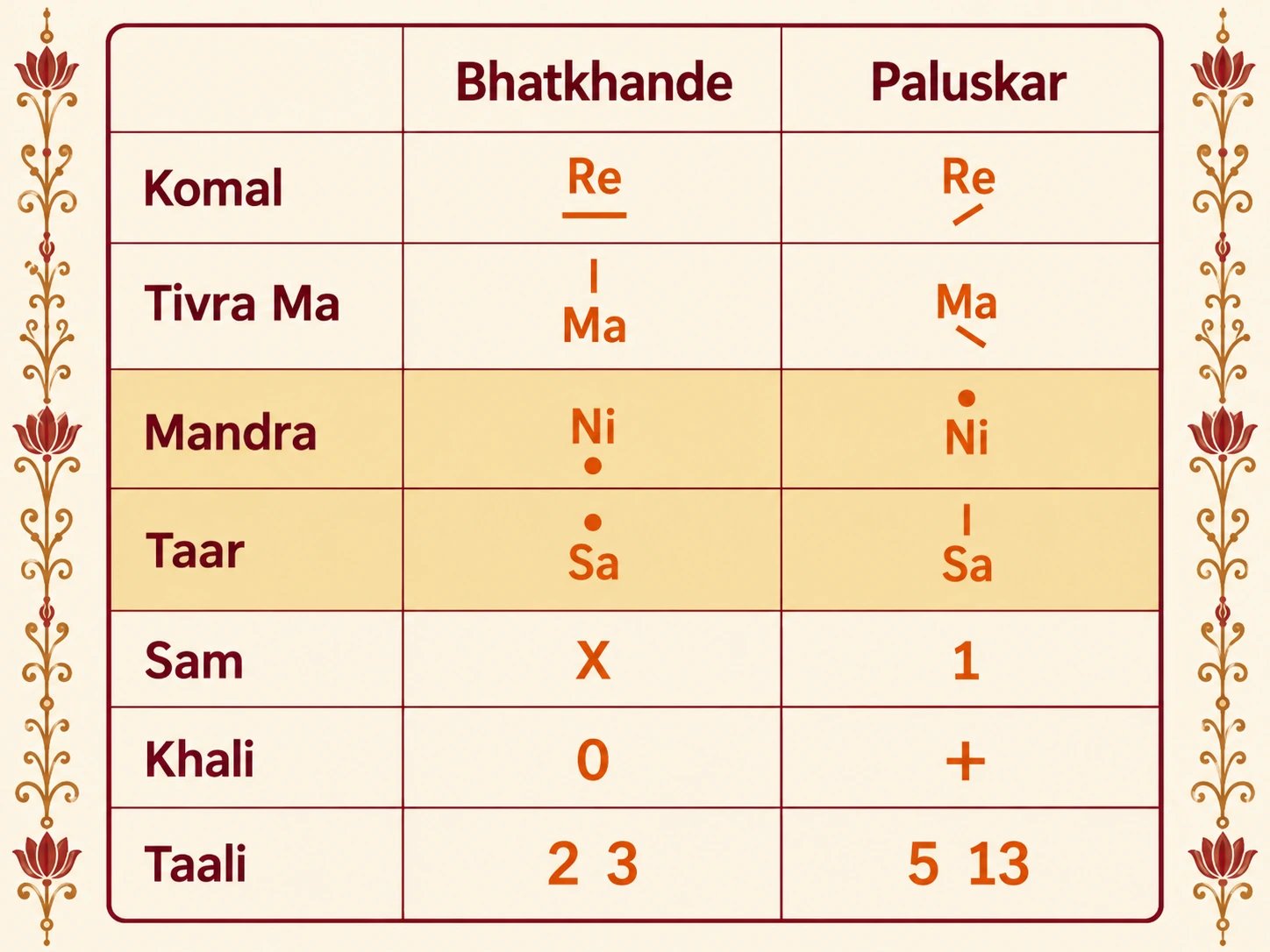
From level 3| Sign for | Bhatkhande | Paluskar |
|---|---|---|
| Komal swara | line below | halant below |
| Tivra म | vertical line above | inverted halant below |
| Mandra saptak | dot below | dot above |
| Taar saptak | dot above | vertical line above |
| Sam | X | 1 |
| Khali | 0 | + |
| Taali | 2, 3, 4 (count of claps) | the matra number |
| Vibhag | line after each vibhag | no vibhag lines; । after each avartan |
| Duration | notes in one matra joined by ‿ | separate signs for 1, ½, ¼ and 2 matras |
| Meend | arc over the notes | arc over the notes |
| Kan | small note above-left | small note above |
Watch the traps: a dot above is taar in Bhatkhande but mandra in Paluskar; a vertical line above is tivra म in Bhatkhande but taar in Paluskar.
Teentaal's signs in each system:
| Matra | 1 | 5 | 9 | 13 |
|---|---|---|---|---|
| Bhatkhande | X | 2 | 0 | 3 |
| Paluskar | 1 | 5 | + | 13 |
Exam practice
From level 3The level 3 paper asks you to recognise the signs of both systems and to write the songs and taals you have learned in them, in thaah and dugun. At level 4 complete knowledge of both is expected, and at level 5 you write every syllabus taal, its dugun and chaugun, and all your bandishes in both.
Practise by taking one bandish you know well and writing it twice, once in each system, on facing pages. Then cover one page and convert the other.
Exam questions
Answer these the way the examiner expects: short and exact.
What is swarlipi? Level 2
The method of writing music down with signs for its swaras and taal.
How is a komal swara written in Bhatkhande notation? Level 2
With a horizontal line below it, e.g. रे॒.
How is a mandra saptak note marked in the Paluskar system? Level 3
With a dot above the note (in Bhatkhande, a dot below).
How are sam and khali marked in the two systems? Level 3
Bhatkhande: sam X, khali 0. Paluskar: sam 1, khali +.
Who devised the two notation systems used in Hindustani music? Level 3
Pt. Vishnu Narayan Bhatkhande and Pt. Vishnu Digambar Paluskar.
Learning this with a teacher
These pages will take you a long way on theory. The singing needs a guru — live online classes, one level at a time, with exam preparation built in.