Ornaments
स्वर अलंकरण
In short
Meend, kan, khatka, murki, gamak and similar techniques that decorate the notes and give singing its grace.
मींड, कण, खटका, मुर्की, गमक जैसी क्रियाएँ जिनसे स्वरों को सजाकर गायन में सौंदर्य लाया जाता है।
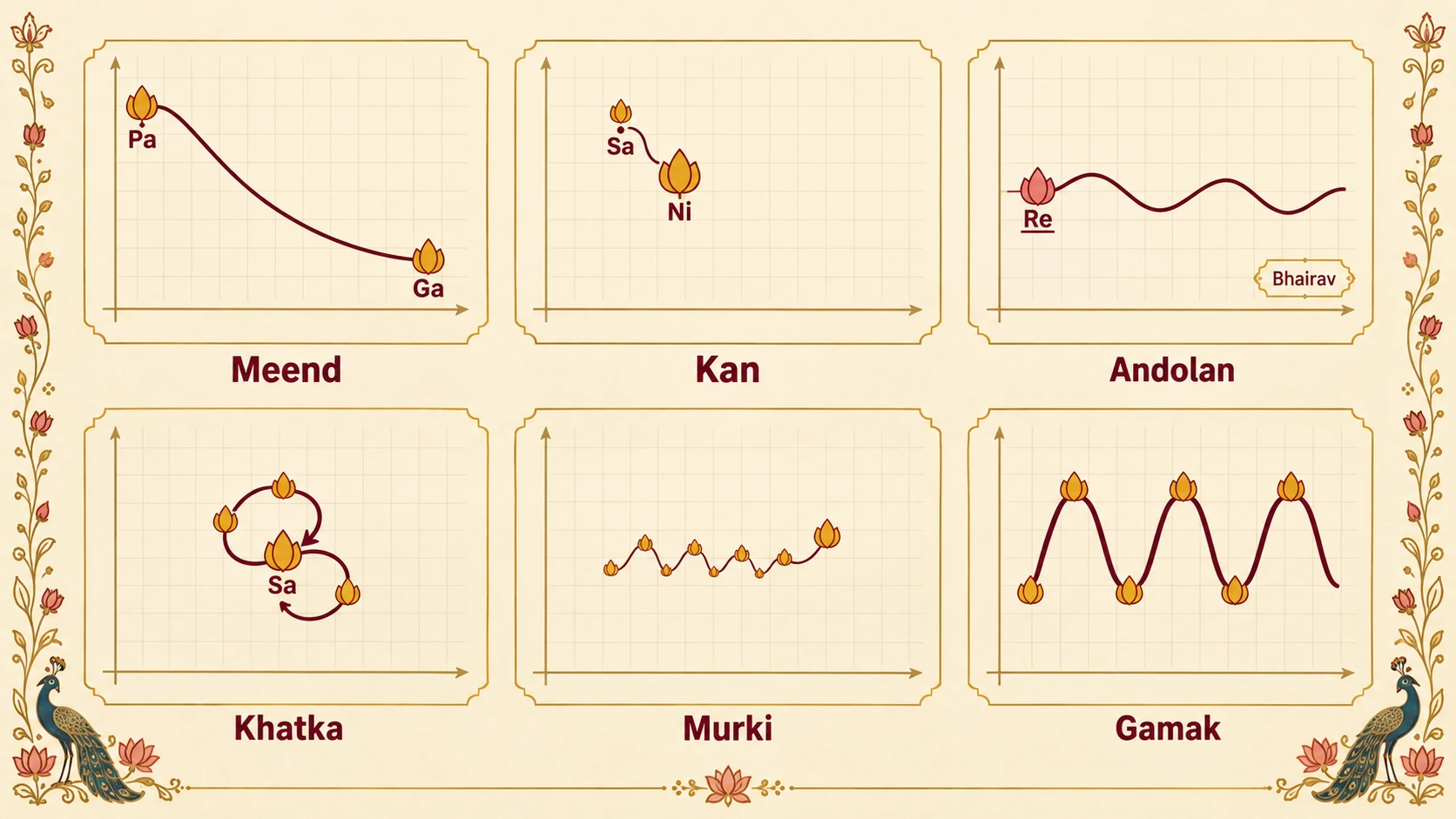
Meend and ghaseet: gliding between notes
From level 3Meend (मींड) is a smooth, unbroken glide from one note to another, passing through the pitches in between without a break in the sound. In Bhupali a slow glide from प down to ग is a typical meend. The sound is like a voice sighing from one note to the next.
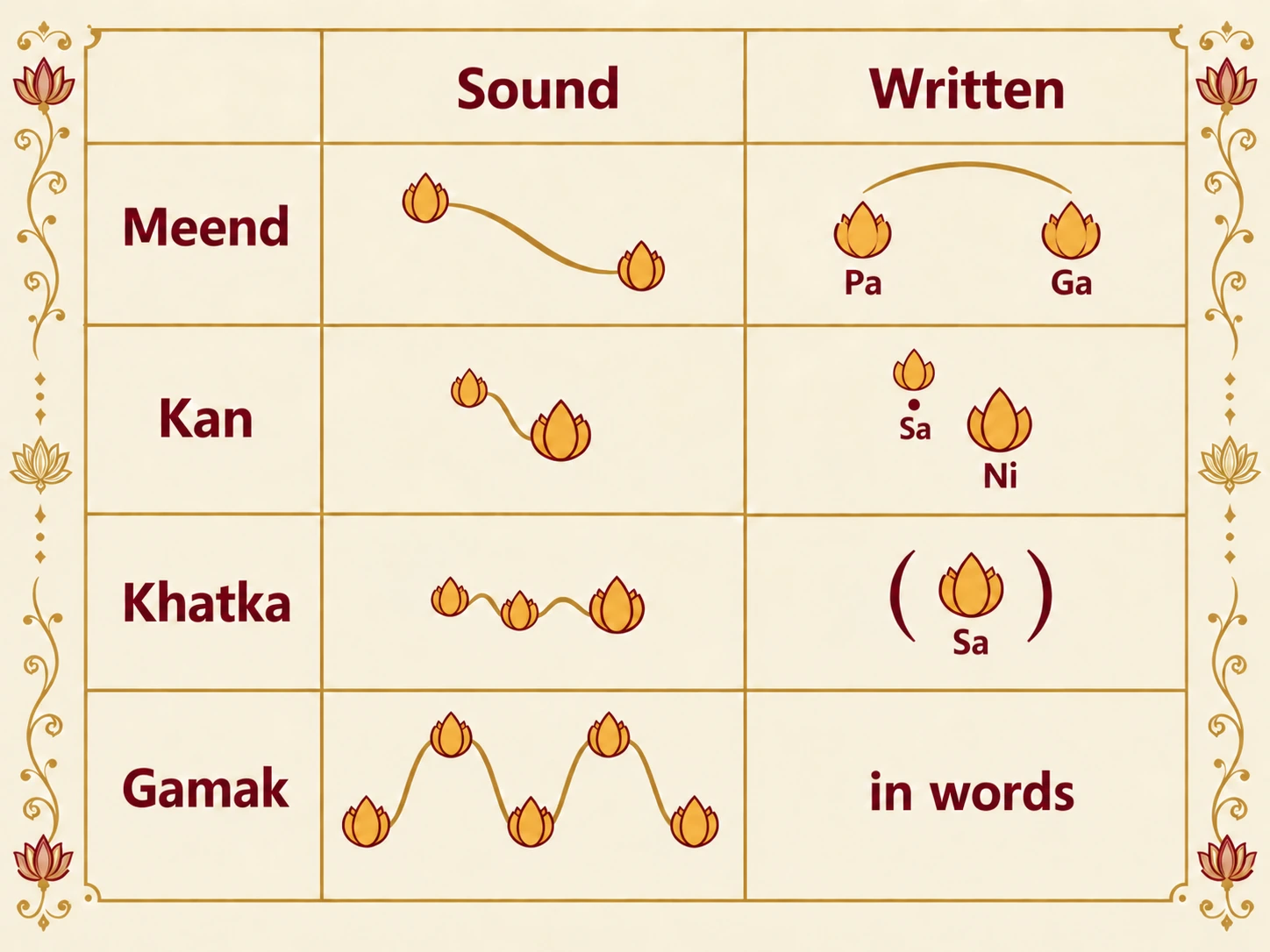
Notation (Bhatkhande): an arc drawn over the notes, from the first to the last: प⌒ग.
Ghaseet (घसीट, "dragging") is a quick, forceful slide across several notes. It is chiefly an instrumental technique: on sitar or sarod the finger is dragged along the string across the frets. In singing it appears as a fast sweep. It is written with the same arc.
Kan or sparsh swar: the touched note
From level 3A kan (कण, "particle") or sparsh swar (स्पर्श स्वर, "touched note") is a very brief touch of a neighbouring note just before the main note. It is heard as a flick of colour, not as a separate note.
Notation (Bhatkhande): the kan is written small, above and to the left of the main note. सांनि means: touch सां for an instant, then sing नि.
Many ragas are recognised partly by their kans. Practise slowly: sing both notes fully, then shorten the first until it is only a touch.
Kampan, andolan and gamak: shaking the note
From level 3- Kampan (कंपन, "trembling"): a slight, quick quiver on a held note.
- Andolan (आंदोलन, "swinging"): a slow, wide swing around a note, touching the neighbouring pitch and returning. The komal रे and komal ध of Bhairav are sung with andolan.
- Gamak (गमक): a forceful, heavy oscillation in which each note is struck with weight, the voice driven from the chest and abdomen. It is characteristic of dhrupad and dhamar, and gives gamak taans their power.
Bhatkhande notation has no single universal sign for these; they are usually written out or labelled in words.
Khatka and murki: quick clusters
From level 4- Khatka (खटका): a quick, forceful cluster of three or four notes around a main note, ending on it. In Bhatkhande notation the main note is written in brackets: (सा) is sung रेसाऩिसा (or ऩिसारेसा), with mandra नि.
- Murki (मुर्की): a lighter, faster and more delicate cluster, typical of thumri and light classical singing and also used in khayal. It is usually written out as small notes.
The difference is weight. A khatka is struck; a murki is flicked. If you can hear every note of it clearly, it is probably a khatka.
Ornaments at a glance
From level 3| Ornament | What you hear | Written (Bhatkhande) |
|---|---|---|
| Meend | a smooth glide between two notes | arc over the notes: प⌒ग |
| Ghaseet | a quick, forceful slide | arc over the notes |
| Kan / sparsh swar | a split-second touch of another note | small note above-left: सांनि |
| Kampan | a slight tremble on a held note | described in words |
| Gamak | a heavy, forceful shake of each note | described in words |
| Khatka | a strong cluster ending on the main note | note in brackets: (सा) |
| Murki | a light, quick cluster | small notes written out |
Exam questions
Answer these the way the examiner expects: short and exact.
What is meend? How is it written? Level 3
A smooth, unbroken glide from one note to another. In Bhatkhande notation, an arc over the notes.
What is a kan swar (sparsh swar)? Level 3
A very brief touch of another note just before the main note, written small above and to the left of it.
What is gamak? Level 3
A forceful oscillation of notes, each struck with weight; typical of dhrupad and dhamar.
How is a khatka written in Bhatkhande notation? Level 4
The main note in brackets, for example (सा), sung as रेसाऩिसा.
Distinguish khatka and murki. Level 4
Both are quick clusters of notes. A khatka is forceful and distinct; a murki is lighter, faster and more delicate.
Related
Learning this with a teacher
These pages will take you a long way on theory. The singing needs a guru — live online classes, one level at a time, with exam preparation built in.