Tarana
तराना
In short
A composition sung on meaningless syllables such as ta, na, dere, tom and nadir, usually in drut laya. Tradition credits Amir Khusrau with creating it.
ता, ना, दे, रे, तोम, नादिर जैसे अर्थहीन बोलों से बना, प्रायः द्रुत लय में गाया जाने वाला गीत प्रकार। परंपरा इसका श्रेय अमीर खुसरो को देती है।
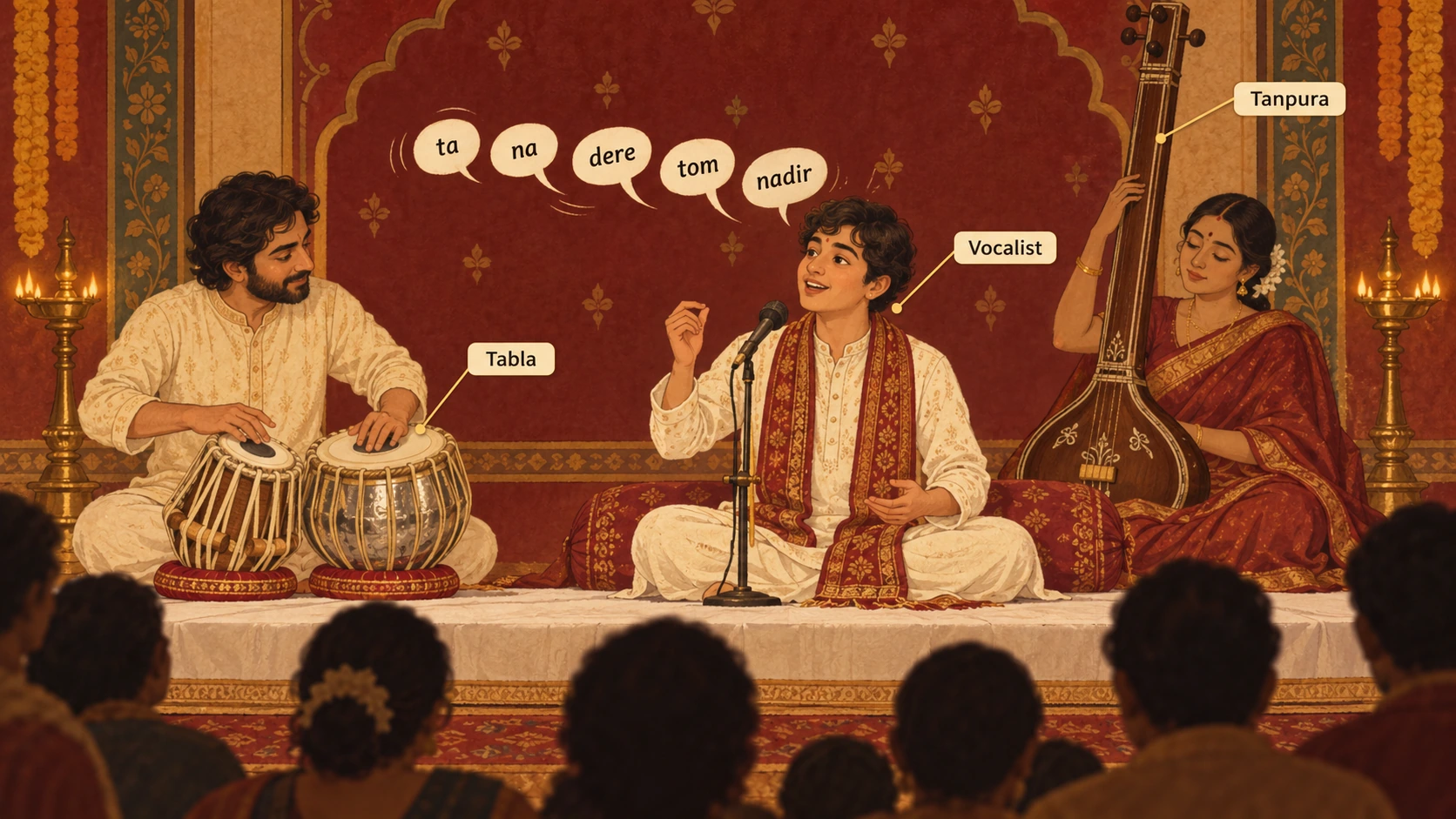
A song without words
From level 3A tarana is a composition in a raga whose text is made of syllables with no dictionary meaning:
ता ना दे रे ना, तोम, दिर दिर, ओदानी, तदानी, यलली, यललूम, नादिर
Freed from words, the voice behaves almost like an instrument, and the syllables are chosen for their rhythmic bite. Taranas are usually sung in drut laya, in Teentaal or drut Ektaal, often right after the chhota khayal as the fast close of a raga.
The Carnatic counterpart is the tillana.
How it is structured
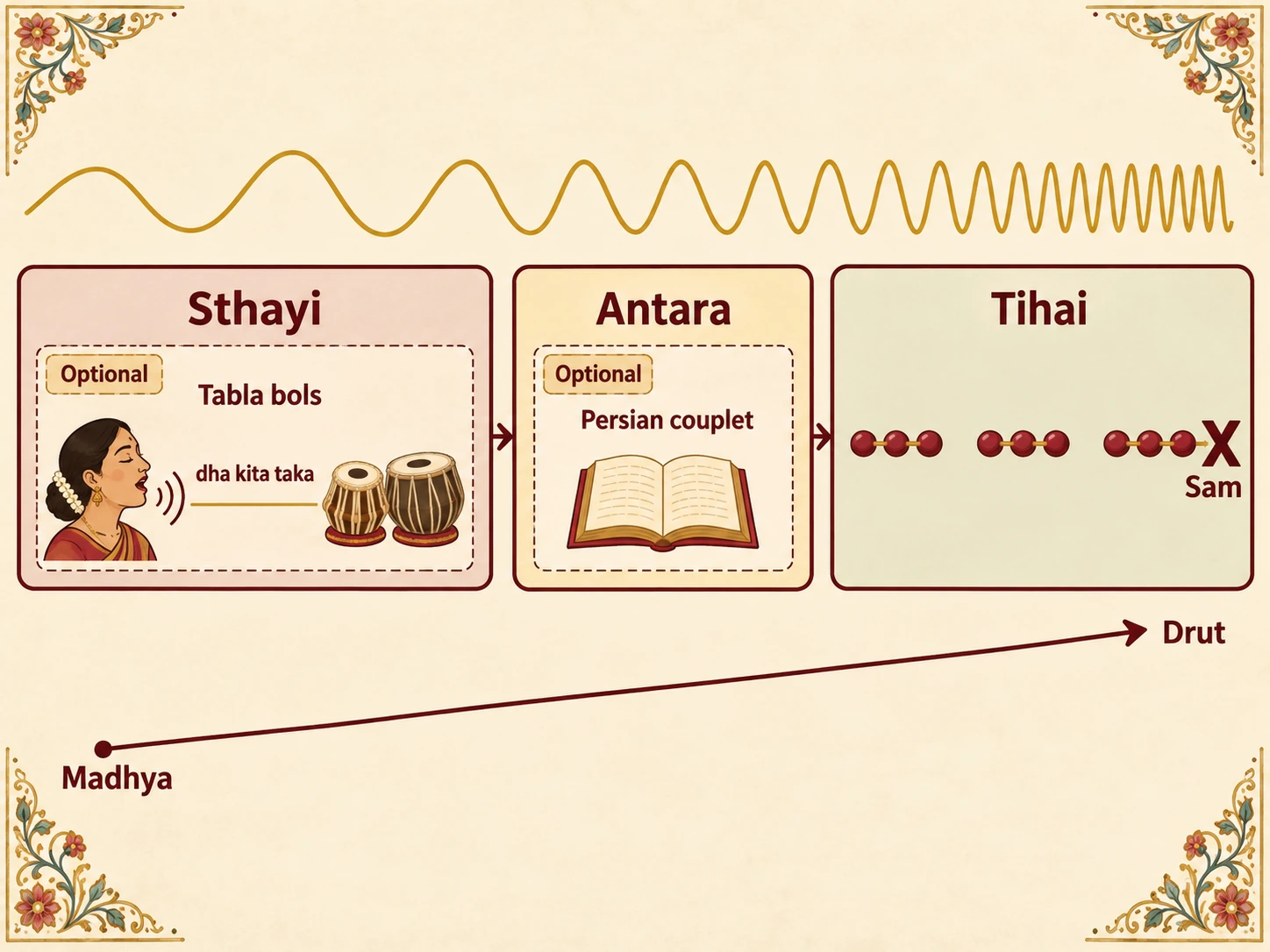
From level 3Like a khayal bandish, a tarana has a sthayi and an antara. Within that frame you may find:
- passages of tabla or pakhawaj bols (such as धा किट तक) sung by the voice;
- occasionally a Persian couplet set in the antara;
- a tihai to finish on sam.
The tempo often rises as the tarana goes on, and the singer improvises by rearranging the syllables rhythmically (a kind of bol-baant). Taans may be sung on the syllables too.
Amir Khusrau and the meaning question
From level 5Tradition holds that Amir Khusrau (1253–1325), poet and musician at the Delhi Sultanate, created the tarana, along with the qawwali. His biography is set at Madhyama Dwitiya.
Whether the syllables mean anything is still debated:
- Some musicians, notably Ustad Amir Khan, argued that they come from Persian and Arabic words with a mystical sense (for example dar, "in", and tan, "body").
- Others note that older Indian treatises already describe songs built on meaningless syllables (shushkakshar), and treat tarana syllables as pure sound.
Either way, sing them for their rhythm and clarity.
How to practise it, and what the examiner listens for
From level 3Practise
- Speak the syllables in rhythm with the taal before singing them. Every consonant should be crisp.
- Sing the tarana at a slow madhya laya first, then raise the speed only as far as you can keep it clean.
- Plan your breaths: drut passages leave no time to gasp in the middle of a phrase.
The examiner listens for
- clear, even syllables, none swallowed at speed;
- a steady drut laya that does not rush;
- the raga's correct notes even at speed;
- clean arrival on sam.
Speed alone earns little. A clear tarana at moderate speed scores better than a blurred fast one.
Exam questions
Answer these the way the examiner expects: short and exact.
What is a tarana? Level 3
A composition in a raga sung on meaningless syllables such as ta, na, dere, tom and nadir, usually in drut laya.
In which laya is a tarana usually sung? Level 3
Drut laya.
How is a tarana different from a sargam geet? Level 3
A tarana uses syllables like ta, na, dere; a sargam geet uses the names of the swaras.
Who is traditionally credited with creating the tarana? Level 5
Amir Khusrau.
What is the Carnatic counterpart of the tarana? Level 6
The tillana.
Related
Learning this with a teacher
These pages will take you a long way on theory. The singing needs a guru — live online classes, one level at a time, with exam preparation built in.