Alankar (Palta)
अलंकार (पलटा)
In short
Systematic patterns of swaras practised in both ascent and descent. They build voice control, accuracy and freedom of movement between notes.
स्वरों के क्रमबद्ध प्रकार, जिनका अभ्यास आरोह और अवरोह दोनों में किया जाता है। इनसे स्वर पर पकड़, शुद्धता और गति सुधरती है।
What an alankar is, and why it matters
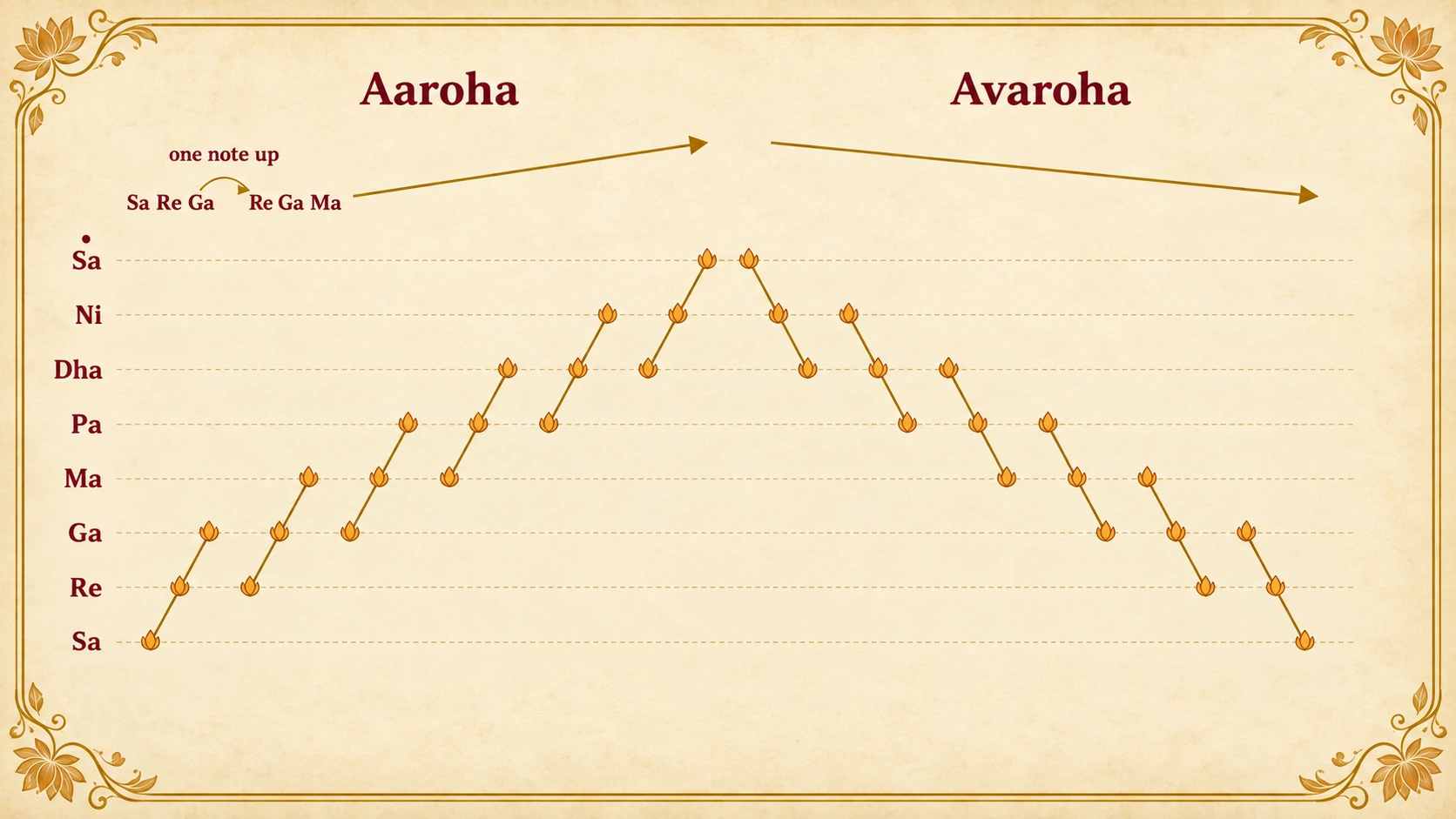
From level 1An alankar (अलंकार, "ornament"), also called a palta (पलटा), is a fixed pattern of notes repeated step by step up the saptak and then mirrored back down. Take the pattern सा रे ग; move it up one note to get रे ग म, then ग म प, and so on to सां; then come down the same way.
Alankars are the scales and exercises of Indian music. They train:
- accuracy (सुर): every note must land exactly in tune with the tanpura;
- control (पकड़): the voice moves where you want, at the speed you want;
- laya: each group fits evenly into the beat;
- memory and grammar: later, the same patterns become the raw material of alaap and taan.
The six Prarambhik alankars
From level 1The ABGMVM syllabus prints the level 1 alankars in this compressed form. The dots mean "continue the pattern up to taar सां", and the part after the gap is the descending half.
- सारेगमपधनीसां
- सारेग, रेगम, गमप सांनीध, नीधप, धपम
- सारेगम, रेगमप, गमपध सांनीधप, नीधपम
- सारेसारेग, रेगरेम.. .... सांनीसांनीध, नीध, नीधप
- साग, रेम, गप, मध.. ...... सांध, नीप, धम
- सा, सारेसा, सारेगरेसा सा सांनीसां, सांनीधनीसां
Written out in full, alankar 2 reads:
सारेग, रेगम, गमप, मपध, पधनि, धनिसां सांनिध, निधप, धपम, पमग, मगरे, गरेसा
Work out every alankar in full like this in your notebook before you sing it.
How to practise
From level 1- Tanpura on, tuned to your सा. Sing a long, steady सा first and match it.
- Thaah first. Sing one note per beat (keep the beat with a slow Teentaal or a metronome). Sing the note names aloud.
- Then dugun. Two notes per beat, same tempo. If any note wobbles, go back to thaah.
- Then in akar (on "आ"), keeping each note distinct without pushing the breath.
- Ascent and descent are equal. Students rush the descent; give it the same care.
Ten minutes daily of slow, perfectly tuned alankars does more than an hour of fast, careless ones. At level 2 the syllabus adds five alankars set to Dadra, Roopak and Teentaal, sung in vilambit and madhya laya; at level 3, six new ones in various layas, and the earlier ones in drut.
Alankars inside a raga
From level 2The level 2 practical asks for one alankar in shuddha swaras and one in a raga. To move an alankar into a raga, run the same pattern on the raga's own notes and skip its varjit notes.
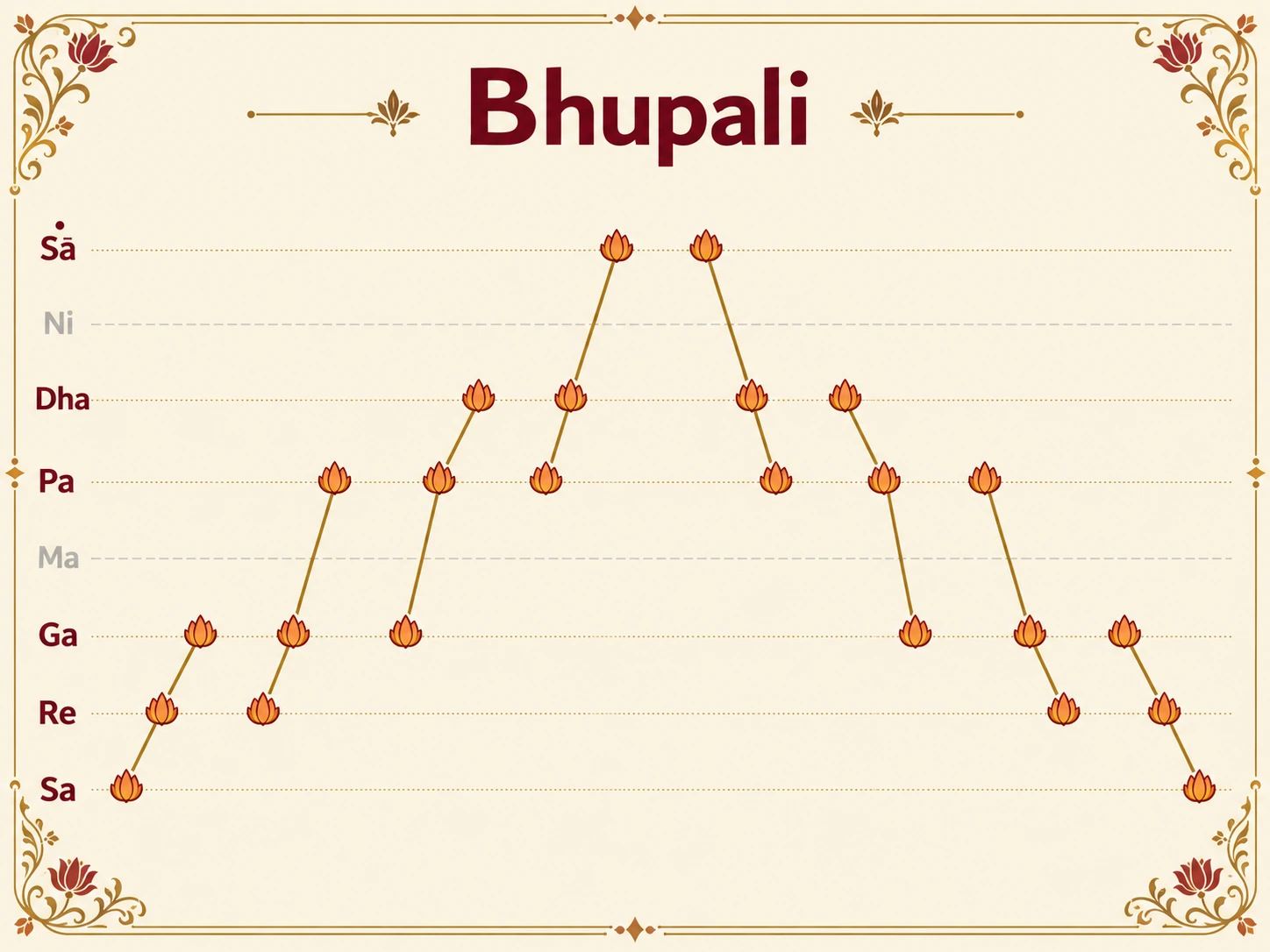
Alankar 2 in Bhupali (no म, no नि):
सारेग, रेगप, गपध, पधसां सांधप, धपग, पगरे, गरेसा
The result already sounds like Bhupali. This is exactly how alankars grow into taans, so once you can do it at level 2, you are halfway to singing taans at level 3.
Exam questions
Answer these the way the examiner expects: short and exact.
What is an alankar? What is its other name? Level 2
A systematic pattern of swaras practised in aaroha and avaroha. It is also called palta.
Why are alankars practised? Level 1
To build accuracy of pitch, voice control, command of laya and freedom of movement between notes.
Write alankar सारेग, रेगम in full, ascending and descending. Level 1
सारेग, रेगम, गमप, मपध, पधनि, धनिसां; सांनिध, निधप, धपम, पमग, मगरे, गरेसा.
How do you sing an alankar in a raga? Level 2
Apply the same pattern using only the raga's notes, leaving out its varjit swaras.
Learning this with a teacher
These pages will take you a long way on theory. The singing needs a guru — live online classes, one level at a time, with exam preparation built in.